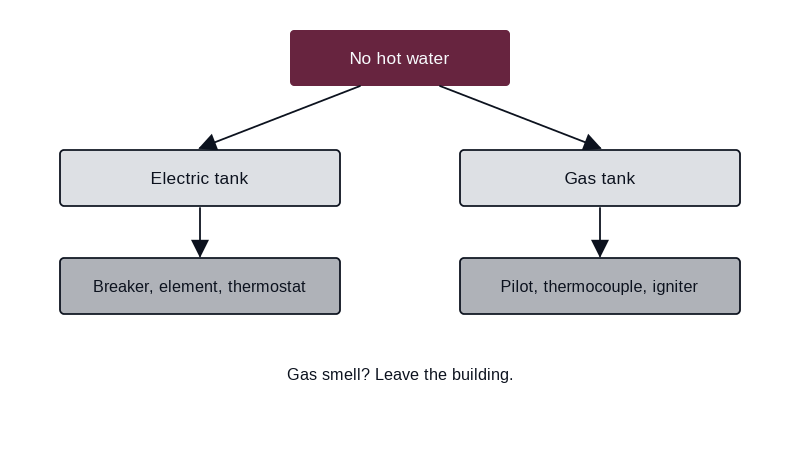
Lukewarm showers in a Bell bungalow seldom mean a dead heater. Usually one part has quit: a thermostat, a heating element, an igniter, a thermocouple or a relief valve. A plumber from the area can open the heater up, identify the failed part and put the price in writing before anything gets touched. Start with the quote form, or browse everything else on Slauson Plumbing.
What will a water heater repair cost in Bell?
A national price guide shows $150 to $750 for a typical repair, averaging about $450. Cheap jobs such as a valve or thermostat land near the bottom, while shell damage lands near the top. Those are published figures from across the country, so a Bell plumber's own price can differ after an inspection of your heater.
Individual jobs in that same guide:
- Valve or thermostat: $75 to $150
- Pilot light: $75 to $175
- Anode rod: $125 to $300
- Heating element or coil: $200 to $750
- Tank or shell repair: $250 to $1,000
Two extras are worth asking about before you say yes. One is a diagnostic or trip fee, listed near $50 and sometimes dropped when you hire the plumber for the fix. The other is an urgent-visit surcharge, shown at $100 to $200. Can the heater wait a day? Mention that on your request and the surcharge need not apply.
Which part usually fails first?
The parts that make the heat, or light the flame, fail first. In an electric tank that means an element or a thermostat. In a gas tank it is an igniter, or a thermocouple that has stopped detecting the pilot flame. Corrosion that lets the shell weep is the other common story, and it is the one fault that normally ends with a new tank rather than a repair.
Use the symptom to guess at the culprit.
| Symptom | Likely cause |
|---|---|
| Nothing hot, electric unit | Breaker, element or thermostat |
| Nothing hot, gas unit, pilot out | Thermocouple, igniter or gas control |
| Warm but not hot, runs out early | One dead element or a cracked dip tube |
| Rumbling or popping sounds | Mineral sediment in the bottom of the tank |
| Damp floor beneath | Fitting, relief valve or a failing tank |
A longer diagnosis is in our guide to why there may be no hot water. For a damp floor underneath, read handling a leaking water heater.
Thermostat, element, igniter: what does each job involve?
Each part has a single role. The thermostat tells the heater when to run, the element is the rod that warms the water in an electric tank, and the igniter starts a gas burner. On a sound tank these are quick swaps, and the tank only needs draining when the part sits below the waterline.
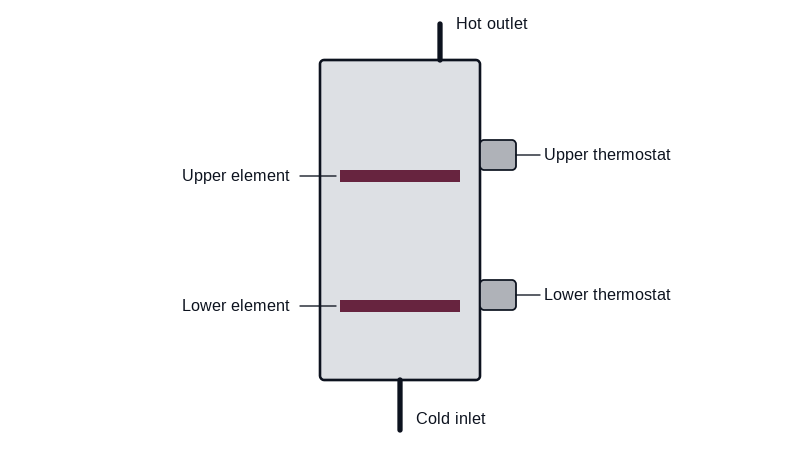
Do not trust the dial on the tank for the real temperature. An electric thermostat measures only at its own height, so water lower down can be much cooler, and a plumber checks what leaves the tap with a thermometer instead. Skin scalds in under five seconds at 140 degrees F, which is why the outlet reading matters.
More detail per part: replacing a water heater element, replacing a thermocouple and swapping an anode rod, the sacrificial rod that slows rust inside the tank.
Does a Rheem, Rinnai, Navien, Noritz or Whirlpool heater get repaired differently?
For the simple tank parts, brand matters little. Rheem and Whirlpool tank heaters are conventional designs, so basic repairs are routine. Rinnai, Navien and Noritz tankless units are different: no stored water, but fans, sensors, a heat exchanger and a display that shows error codes. Read the code or the model number off the label before booking.
Giving the plumber that model number ahead of time avoids a second trip for a missing part. Brand-by-brand tankless write-ups: Rheem tankless repair, Rinnai repair, then Navien and Noritz fixes.
Heat pump water heaters sit in a class of their own. They pull heat out of the surrounding air and push it into the tank, and manufacturers advertise efficiency far above plain resistance heating. Extra parts, a fan, a compressor and a condensate drain, mean extra things that can fail, so choose a plumber who has worked on that specific model.
When is replacing smarter than repairing?
A leaking or aged tank should be replaced, while a healthy tank with an inexpensive failed part is worth fixing. A national guide suggests that a repair quote near $1,000 is the point to compare against a new heater, which it prices at $600 to $1,500 for the unit alone. Age tips the balance too: it lists 8 to 10 years as typical for a tank.
A home-inspector association gives 6 to 12 years for a conventional tank and about 10 for a tankless unit. Installed costs sit higher than unit prices. The same national guide shows $900 to $3,000 for a natural gas tank installation, averaging $1,400. Permit fees vary by city, so ask for them listed separately.
Think of two extremes: a twelve-year-old tank sitting in a puddle belongs in the dump, while a five-year-old heater with a dead element is worth saving. Replacement pricing gets fuller treatment under water heater replacement cost, while when a heater is due for replacement tackles age.
How big a water heater does my household need?
Size to the busiest hour of hot water use. Tank labels list a first hour rating, the hot water a full unit can deliver in sixty minutes, and the right figure matches the hour when showers, laundry and dishwasher overlap. Gallons alone are a rough proxy only. Headcount under your roof tells a plumber far more about the real demand.
Rough guides, not code figures: 20 gallons covers one or two light users, 40 gallons is a common pick for three or four people, and a household of five tends to outgrow 40 gallons and move up to 50 or more. Remember the space, too. Small 1920s to 1950s houses around Bell often squeeze the heater into a closet or the corner of a garage, and a bigger tank has to fit there and still vent safely.
Tankless units free the floor space and end the running-out problem, at a higher upfront price. Compare them in tank versus tankless and read the tankless installation cost guide.
What is the timeline for a heater swap, and which permits apply?
Expect a straight tank-for-tank exchange to occupy roughly half a day, although the plumber confirms the real estimate at the house. Time goes into draining the old unit, unhooking it, setting the new one in place, reconnecting water plus gas or power, then testing. Tired vents, gas shutoffs and drain pans can add hours, especially in older homes.
Replacement normally comes with a permit. In Bell, the Building and Safety counter at City Hall, 6330 Pine Ave, handles them, and the city's building permits page explains the application. Under California contractor rules, work above $1,000 in labor and materials generally needs a license, and anything that calls for a permit needs one whatever its size. Gas and venting work belongs with a contractor, not a weekend project.
Smell gas? Walk outside first and leave every switch alone. Once in the yard, notify the gas utility, or dial 911 when someone is at risk. A soaked tank with no gas odor is a different case: close the cold supply above it, switch off the power or the gas control, and wait for the plumber.
How do I request a heater visit?
Fill in the quote form with your street, whether the heater runs on gas or electric, the brand printed on the label, and what is going wrong. A local plumbing business receives the request and replies with an arrival window and a written price. Someone reads submissions Monday to Friday, 9am to 5pm, and an email address sits at the top of every page.
Common questions
Can a plumber fix a hot water heater, or does it need replacing?
Usually the plumber can fix it. Controls, burners, valves and rods are routine work, and tankless error codes can be traced to a part. A corroded shell that seeps water through the tank wall is the exception, and that heater is replaced. Describe the symptom and brand on the form so a suitable plumber comes.
Which plumber suits a tankless or heat pump heater?
Any plumber covers conventional gas and electric tanks. Tankless and heat pump models rely on sensors, fans and error codes, so ask for someone experienced with that brand. A gas smell overrides everything else: leave the house, then tell the gas utility from outdoors.
What should a water heater fix cost?
A national price guide shows $150 to $750, with the average near $450. A thermostat or valve runs about $75 to $150, an anode rod $125 to $300 and a heating element $200 to $750. Treat those as published guide numbers, because urgency, parts and access change what the plumber writes on your quote.
Is the heater to blame, or the pipework?
If only hot water misbehaves, suspect the heater. If cold flow is weak too, look upstream at the incoming line, the pressure valve or a section of pipe. One tap with no hot water while the shower runs hot usually points at a valve or cartridge at that fixture. Pressure complaints are covered in hot water pressure low.
Are heat pump water heaters harder to repair?
Somewhat. A heat pump unit adds a fan, compressor and condensate line to the usual tank parts, so the plumber needs experience with it. Plenty of faults are simple, like a clogged filter or a blocked drain line. Give the model number when you book and we will point the visit toward someone who works on that type.
In this section
- Water heaters
Water heater leaking or no hot water in Bell?
- Anode rod water heater
When a water heater anode rod needs replacing, how to inspect one, what the job involves in Bell homes and when to hand it to a plumber…
- Hot water heater replacement cost
How much does a hot water heater replacement cost?
- Gas tankless installation
What a gas tankless water heater install needs in a Bell home: gas line size, venting, condensate, permits and the checks a plumber should…
- Hot water heater repair
What can go wrong with a hot water heater, which faults are repairable, what to check before you arrange a plumber, and when replacement…
- Hot water pressure low
Weak flow on the hot side only, or on hot and cold?
- Hot water pressure regulator
Is there a pressure regulator for hot water?
- Water heater leak repair
Water around your water heater? Find the source, learn which leaks are a quick fix and which mean a new tank, plus costs and why tankless…
- Installation tankless water heater
Tankless water heater installation cost explained for Bell homes, with national price guides, what adds to the bill, and what smaller…
- Mobile home water heater
What replacing a water heater in a mobile or manufactured home costs, using national price guides, plus the permit, access and venting…
- Navien tankless water heater installation
What a Navien tankless install involves in a Bell home: gas line size, venting, condensate drain, recirculation and permits, plus what to…
- Navien tankless water heater
Navien tankless heater giving cold water, errors or weak flow?
- No hot water kitchen
Hot water works in the shower but not at the kitchen sink?
- Noritz tankless water heater repair
Noritz tankless water heater not working?
- Plumber for water heater
Water heater leaking in Bell? Shut off water and power or gas, find where it drips from, and learn what code, permits and tankless…
- Plumber for water heater replacement
What a plumber does on a water heater replacement in Bell: sizing, venting, permits, haul-away, timeline, and the questions to ask before…
- Replacement water heater element
Electric water heater lukewarm or cold? Learn how to tell a dead element from a bad thermostat, what a replacement involves, typical…
- Rheem tankless water heater
Rheem tankless water heater not working in Bell?
- Rinnai tankless water heater
The work behind a Rinnai tankless water heater install in a Bell home: gas supply, venting, power, permit, picking a model and what to ask…
- Rinnai tankless water heater
Rinnai tankless water heater not working?
- Shower no hot water
Shower runs cold but the sinks are hot, or everything is cold?
- Tankless gas water heater vs tank
Tankless gas water heater vs tank: standby loss, hot water supply, energy savings, lifespan, gas line and venting needs, and the cost…
- Tankless water heater replacement
What tankless water heater replacement costs: published national ranges for the unit, labor, gas line and old-heater removal, and how to…
- Thermocouple water heater replacement
Pilot won't stay lit on a gas water heater?
- Water heater expansion tank
Water heater expansion tank replacement in Bell: what the tank does, signs it has failed, how a plumber swaps it and what to ask about…
- Water heater relief valve
A dripping or stuck relief valve on a water heater needs attention.
- Water heater replacement cost
What replacing a 50 gallon water heater costs in Bell: guide prices for gas and electric, the line items behind the total, permits and how…
- Water heater, no hot water
Heater seems to run but the taps stay cold or lukewarm?
- Water heaters
How often a water heater needs replacing: tank and tankless lifespans, warning signs, anode rod timing, and how hard water in the Gateway…
- Water heaters
Tank or tankless water heater for a Bell home?
- Costs
What water heater replacement costs in Bell: published price ranges by tank size and type, what adds to the bill, and what to ask before…
- Water heaters
Cold taps at home in Bell? Check the breaker, the pilot and the thermostat, learn what each symptom means, and see when a plumber should…