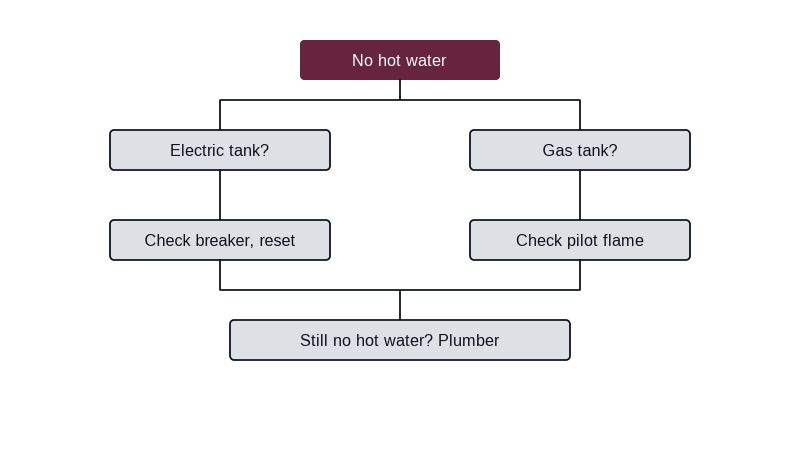
Sorting by fuel is the fastest route. An electric heater that goes cold has usually lost power, a heating element or a thermostat. A gas heater has usually lost its flame. A unit that produces some hot water and then runs out quickly has yet another fault. Each fix is described on the water heater repair page, and the Slauson Plumbing home page names the other work we set up around the Gateway cities.
What has failed when the hot water disappears?
Usually one small part. On an electric tank that means a tripped breaker, a dead heating element or a thermostat that no longer passes power. On gas it means a pilot flame that went out, a thermocouple that no longer detects it, or a gas control that stopped opening. The tank itself is rarely the culprit on day one.
Begin with simple questions. Did the power or gas go off recently? Is only one tap cold or all of them? Is the cold water cold, or only lukewarm? Hot water at the bathtub but not the kitchen sink points to a pipe or mixing fault, not the heater, and it has its own write-up on a kitchen sink with no hot water.
Which checks come first on an electric water heater?
Check the breaker, then the reset button. A heater that lost power at the panel will be stone cold, and one tripped breaker can be a one-off. Many electric tanks have a reset button behind a small panel, which trips when the water overheats. Pressing it once is reasonable. If the breaker or button trips again, stop and arrange a visit, because something is failing.
Shut the breaker off before touching any panel on the tank, and never open an electrical panel with wet hands or standing water around. Swapping a heating element or a thermostat is work for the plumber, and the tank needs a little time to warm up afterward.
What should you check on a gas water heater?
Look at the pilot window and the control knob. A pilot that blew out can be relit using the instructions printed on the heater. A flame that will not stay lit usually means a worn thermocouple. The smell of gas changes everything: leave the building, reach the gas utility's emergency line once you are outside, and use 911 if you feel in danger. Leave switches alone on the way out.
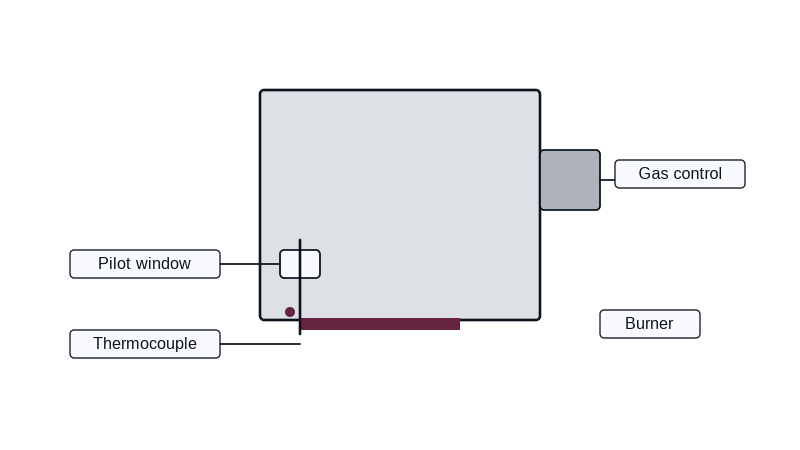
Gas piping and appliance connections are regulated work. Relighting a pilot is the only repair the label asks of a homeowner. Anything beyond that, the gas control valve included, is for a contractor, and swapping the whole heater requires a city permit.
What does it mean when hot water runs out fast?
Water that is lukewarm and turns cold within minutes usually points to a failed lower heating element on an electric tank, a broken dip tube that lets cold water flow directly into the outlet, or sediment insulating the burner on a gas tank. Wikipedia notes that a tank recovers slowly after heavy use, so two long showers back to back can empty it with nothing wrong.
A tank thermostat is also an unreliable guide to the temperature inside the tank, because it reads only at its own height. Water lower down may be cooler. A plumber checks with a thermometer at the tap instead.
Why is the hot water gone in my apartment or rental?
Renters should notify the landlord or building manager first, because the heater may be shared, may sit in a closet you cannot reach, or may belong to the building. Many homes in the Gateway cities are rented. Wikipedia puts renters at 76.5 percent of occupied homes in Bell Gardens and 70.3 percent in Maywood, so this is common here.
Record the time it stopped, whether neighbors lost hot water too, and which checks you have done. A shared system serving several units is a building-wide problem; a single-unit tank is a tenant-landlord repair. Do not attempt anything on a gas appliance in a unit that is not yours.
What if the hot water fails on a boiler system?
A boiler that heats water for taps rather than only for radiators is less common in single-family homes, and it is a specialist job. The checks mirror the tank: power, fuel, pilot or ignition, and the thermostat. Past that point, a boiler is a pressurized vessel and a plumber or heating contractor should look at it. If it belongs to a building, report it to the manager.
What if it is a Rheem or another named brand?
Brand matters less than the symptom. A Rheem, A. O. Smith or Bradford White tank fails in the same ways as any other tank, and the owner's manual supplied with the heater has a troubleshooting chart for that model. Have the model and serial numbers from the rating plate ready for anyone you contact, since parts depend on them.
Who should you contact when the hot water is gone?
Reach out to a plumber if a reset will not hold, water pools around the tank, gas is in the air, or the heater is old. Most tanks last around eight to ten years, a national guide says, and a repair quote of $1,000 or more may make a new heater the better value. A relief valve, thermostat or pilot repair costs far less than that.
On one national price list, repairs range from about $75 for a pilot or thermostat fix to $750 for a heating element, with $150 to $325 for a thermocouple and an overall average near $450. Urgent visits add $100 to $200. Treat all of this as a guide, since the plumber's written quote is the real price.
In California, a contractor license is needed for jobs worth $1,000 or more in labor plus materials, and for any permitted job. A new heater typically triggers a permit, so find out from the plumber who obtains it and confirm with the city's building office. Use the quote form to give the heater type and the checks you made. Weekdays, nine to five, is when submissions get read.
Common questions
How soon will the hot water return?
A reset or a pilot relight takes minutes. Replacing a thermostat, element or thermocouple is usually a short visit if the plumber carries the part, and an electric tank needs a little time afterward to warm up. A whole new heater takes longer, often a half day. The plumber can give you a time when the visit is booked.
Is no hot water an emergency?
It is urgent, but not dangerous by itself. The dangers are a gas smell, water pouring from the tank or a hissing relief valve. In those cases shut the water or power off and arrange help at once. Otherwise, check the simple items, boil a kettle for washing and book a visit.
Is a lack of hot water something I can repair on my own?
A breaker reset, one press of the reset button and a pilot relight per the label are all within reach. Leave gas controls, rewiring and parts under pressure alone. Wikipedia says that at 140 degrees F scalding can occur within five seconds, so a heater turned up to fix the problem is a hazard.
Why is my hot water lukewarm only?
Lukewarm points to a failed element, a thermostat set too low, sediment or a broken dip tube. After heavy use it may simply be recovering. If it stays lukewarm for a full day, something is failing, and a plumber can test each part in one visit.