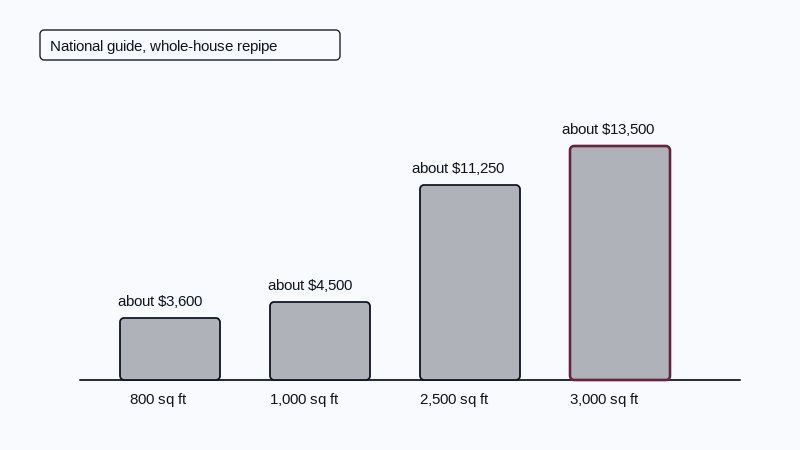
Across the country, a complete repipe averages around $7,500, with published guides spanning $1,500 up to $15,000. Where you fall in that spread depends on the size of the house, the pipe material and the difficulty of reaching the existing lines. Bell prices may differ, so treat each number here as a national guide, not a quote from Slauson Plumbing. The hub page on repiping and pipe replacement gives the wider picture.
Learn what drives cost before you ask anyone for a price, and bids become easier to compare. Below you will find typical figures, a back-of-envelope sum you can do yourself, and the questions that show up a thin quote.
What is the typical total for a whole-house repipe?
A full repipe averages near $7,500 nationally, and the published prices go from $1,500 to $15,000. Mobile homes and small houses sit at the bottom, while large two-story homes plumbed in copper reach the top. One guide lists $1,500 through $4,000 for a mobile home. Only the written quote fixes the real price.
Sources disagree on mid-size homes. One national guide prices a three-bedroom house of 1,500 square feet at $2,280 through $5,120, yet another table puts that size near $6,750. Gaps like that are normal, so collect more than one local quote and ask what each includes.
| Home size | National guide figure |
|---|---|
| Mobile home | $1,500 to $4,000 |
| About 800 sq ft | about $3,600 |
| About 1,000 sq ft | about $4,500 |
| About 1,500 sq ft | $2,280 to $5,120 or about $6,750, depending on the source |
| About 2,500 sq ft | about $11,250 |
| About 3,000 sq ft | about $13,500 |
What does a repipe cost per square foot?
Working backward from the table above yields roughly $4.50 per square foot (our own arithmetic on one national guide's numbers, not a rate any plumber has promised). On that basis a 1,200-square-foot home lands near $5,400. Fixture count, access and material move the real figure, so treat square footage as a first budget guess only.
The method is simple: multiply the floor area by 4.50, then adjust. Add for each extra bathroom or awkward wall, and trim for a short, easy run. No website can see inside your walls, so the written quote after a walkthrough replaces any estimate.
What would a single bathroom or a compact house cost?
No guide publishes a separate price for piping one bathroom, because the work is normally quoted per fixture and per length of run. The national table puts a small house of 800 to 1,000 square feet near $3,600 to $4,500. When just a portion of the home needs work, ask the plumber to price a bathroom line separately.
A partial job fits when only one branch is failing. Typical extras include a new water main, which one guide prices at $600 to $2,500, and inspection fees of $250 to $1,200, both national figures.
What pushes a repipe price up or down?
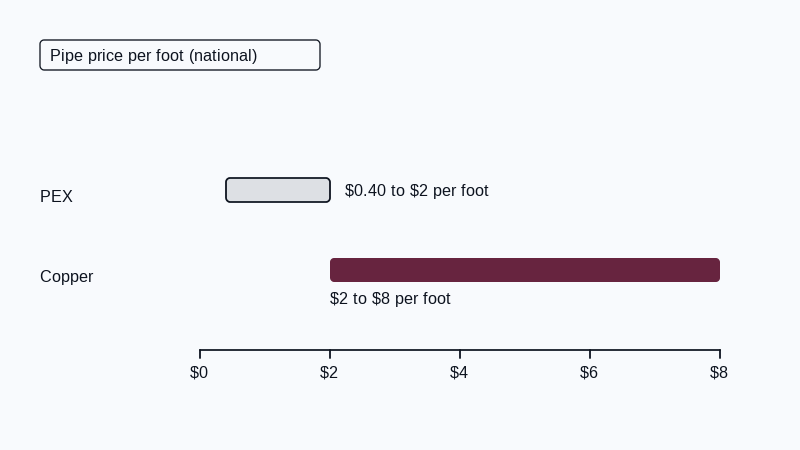
Pipe material, house size and access move the total most. PEX is the cheapest tubing at $0.40 up to $2 per linear foot, while copper runs roughly $2 up to $8 per foot, and labor makes up the larger share. Two-story houses, finished ceilings, slab foundations and cramped crawlspaces all add labor hours.
Other factors worth asking about:
- Material. PEX is flexible, needs no soldering and is usually quicker to install; copper costs more in tubing and labor. See PEX vs copper.
- Permit and inspection. One guide lists permits at $50 to $500.
- Wall repair. Drywall repair runs about $50 to $75 a square foot in the same guide, and is not always in the repipe quote.
- Old pipe condition. Polybutylene or heavily scaled galvanized steel can mean more openings; see polybutylene pipe replacement.
- Fixture count. More taps, more branches, more hours.
- Labor rate. Hourly plumber rates in one guide run from $45 to $200.
How do you compare repipe quotes?
Line up identical items in each quote: pipe type and brand, fixture count, permit, wall repair, paint, old-pipe removal, start and end dates, and who applies for the permit. A bid leaving out drywall or the permit can look cheaper and cost more later. The contractor license number belongs on the paperwork.
California caps a deposit at $1,000 or 10 percent of the contract price, whichever is less. Licensing is generally required when labor and materials together reach $1,000, and for any job involving a permit. A repipe meets both conditions, so verify the contractor on the state licensing board's website before signing. Do not pick on price alone: weigh what each material offers, such as fewer joints and a quicker install with PEX, against what copper adds.
If a bid shows one lump sum, ask for it split into material, labor and repairs. Once you are ready, enter the job in the quote form. The Slauson Plumbing home page lists all the work we arrange.
Common questions
What is the time frame for a repipe?
Expect one to three working days for a small house, with the water off for part of each day. Larger homes, slab houses and copper jobs take longer. Get start and finish dates in writing, along with the plumber's plan for hidden damage turning up in drywall behind a fixture.
Which points should I settle before hiring a repiper?
Cover pipe material and fittings, the permit, who patches and paints the walls, the schedule, payment terms and the contractor license number. Also ask what happens if extra damage appears behind a wall. A written breakdown makes quotes fair to compare.
Is a partial repipe possible?
It is, provided the rest of the system is in good shape. Many plumbers will replace a single branch, a kitchen or a bathroom run, and leave the remainder for later. The downside is that old pipe joined to new can keep corroding, so request the plumber's candid opinion about a partial job.
What about polybutylene or old galvanized pipe in my house?
Polybutylene went into several million North American homes between about 1978 and 1997, and it can fail with no warning, so full replacement is the lasting fix. Galvanized pipe clogs from the inside over time. Either one can raise the price because more walls need opening.