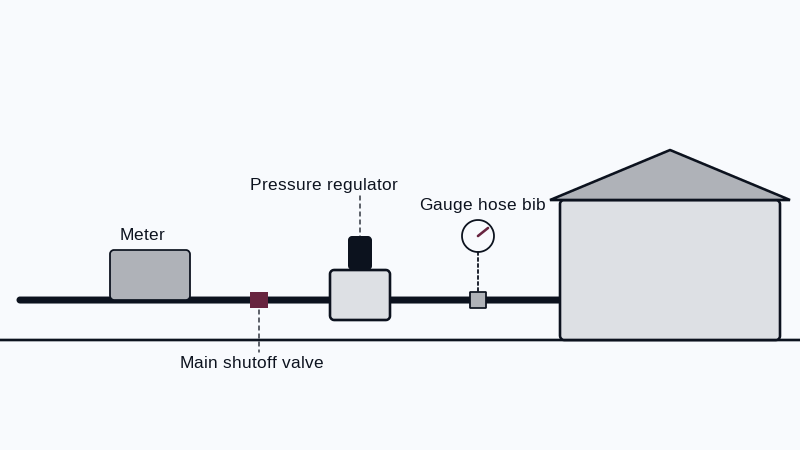
Installed on the pipe right where water comes into the house, a regulator keeps pressure steady and safe for fixtures and appliances. Pipe size is the first spec: a 3/4 inch regulator fits a 3/4 inch line. When your pressure swings or runs high, start at plumbing for low or uneven water pressure, and come back here when it is time to pick the part. A local plumber is arranged through the quote form.
Does a 3/4 inch regulator fit my house?
Match the regulator to the pipe it will go on, which in many single-family homes is the 3/4 inch line after the meter and main shutoff. Check the pipe and not the meter: measure around the pipe and compare against a size chart, or read the size stamped on the existing valve. For a 1 inch house line, buy a regulator of that size.
Sizing involves more than the pipe. The Pacific Northwest National Laboratory advises choosing a regulator whose working pressure sits in the middle of its rated range, and holding minimum flow through the valve at roughly 10 to 15 percent of the maximum flow you want. That detail is for the installer, since an oversized valve can chatter at low flow. Bigger is not automatically better. A small branch line is a different case, covered in the quarter-inch regulator guide.
Read the nameplate on the old regulator. It often shows size, the factory pressure setting and a model number. Compare it with the pipe, take a photo, and bring both to any parts counter or attach the photo to your request. Pipes of other sizes have their own pages: one-inch regulators and half-inch regulators.
What pressure should a 3/4 inch regulator be set to?
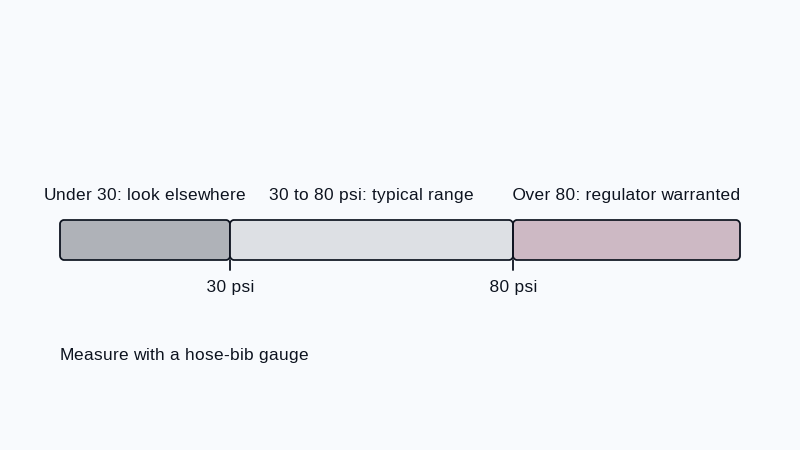
A district guide says household plumbing generally wants 30 to 80 psi, and many regulators come set near 50 psi. Building guidance often suggests keeping static pressure moderate, and many codes call for a regulator once supply pressure runs high. Read the gauge before changing the setting.
To measure pressure, thread a hose-bib gauge onto an outside tap, shut every fixture in the house, and read the gauge. Repeat the test across the day, since pressure often rises overnight when demand drops. A reading above 80 justifies a regulator. A reading under about 30 is different: a regulator cannot create pressure that is missing, so look at sudden low water pressure for other causes.
To adjust a regulator, loosen the locknut, turn the adjusting screw slightly at a time, and recheck the gauge. Keep a tap open while you do, as the number shifts under flow. The setting must also leave appliances well supplied. Washing machines and dishwashers work better with steady flow.
Where does a 3/4 inch regulator go, and does it need an expansion tank?
In single-family homes it normally goes on the supply line where it enters the building, beyond the meter and main valve, which puts every fixture after it. PNNL says all fixture connections should be downstream of the regulator. Fitting one can seal the plumbing as a closed loop, which lets heat expansion from the water heater push pressure up; local code and the plumber settle the question of an expansion tank.
In older Gateway-city homes, bungalows built between the 1920s and the 1950s often have the meter and shutoff at the front or side of the lot, with the house line running along a wall or crawlspace. A regulator may sit near the shutoff or by a front hose bib. Look for a bronze or brass bell-shaped body topped with a screw. Two guides help: finding the regulator in a house and its usual appearance.
On ownership, a district page says the customer installs and maintains any regulator downstream of the meter. Look at your water bill to see who the provider is; the pipe ahead of the meter is that provider's responsibility.
How can I tell a regulator is going bad?
A failing regulator tends to produce fluctuating or weak pressure, no pressure, banging or vibrating pipes, or unusually high pressure. High pressure can lead to dripping faucets, running toilets and leaking appliances. Regulators typically last about 10 to 15 years, and some are cheaper to service with a rebuild kit than to replace.
PNNL links excess pressure to leaking faucets, ruptured pipes or hoses, leaking water heaters and noisy dishwashers and washing machines. If you hear water hammer, see water hammer sounds. If your regulator is old and stuck, swapping out a water pressure regulator covers the job.
Can I install a 3/4 inch regulator myself?
Sometimes, but the swap means cutting into the main supply pipe, and one mistake floods the house. The work often needs soldered or compression fittings, and some cities require a permit. California sets its contractor-license line at $1,000 for labor plus materials, and any job needing a permit goes beyond it. If unsure, hand the job on through the quote form.
Anyone attempting it should close the main valve and empty the line through an open tap. Note the flow arrow on the valve, fit unions so the body can come off later, and test at several taps. Watch for leaks over a day. Many city building offices, Bell Building and Safety among them, can say whether a permit applies. Requests are read on weekdays between 9am and 5pm, and this site has no emergency dispatch. Other jobs we arrange appear on the Slauson Plumbing home page.
Common questions
What is the time needed for a regulator swap?
With the right fittings on hand, a plumber usually takes a few hours to close the water, cut in the new valve, set the pressure and test it. Old corroded pipe or a missing shutoff can stretch the visit. Allow time without water, and make sure the house is accessible.
Does a regulator reduce water flow?
A properly sized regulator lowers pressure and not usable flow, but an undersized or clogged one can restrict flow and make showers feel weak. If flow drops after a replacement, ask the plumber to check the setting and the strainer. Low pressure on only the hot side is a different fault.
Which details should be settled before the regulator goes in?
Request the target setting, gauge readings taken before and after, advice on an expansion tank, and word on any permit. Confirm the plumber carries insurance and get the figure in writing. You can verify the contractor license on the state board's website.
What if a failed regulator is never replaced?
A regulator that has failed can pass full street pressure into your pipes, straining fittings, fixtures and the water heater, and possibly causing leaks or a burst. Not every home has one, since pressure varies by street. A gauge reading is the way to learn whether yours needs attention.