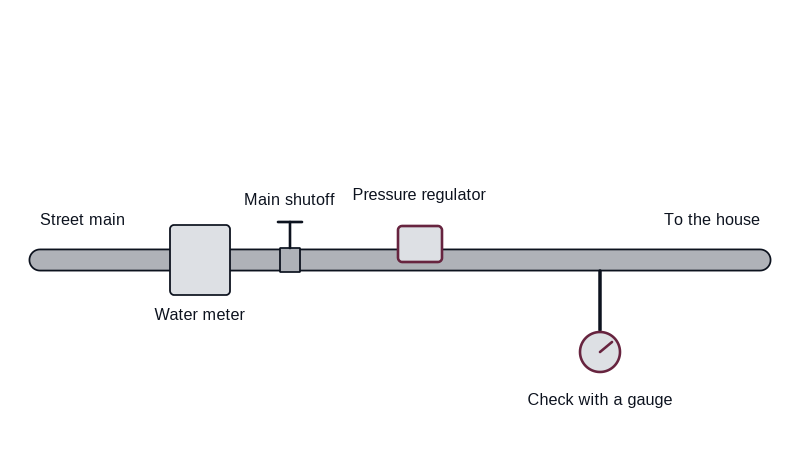
Weak flow from every faucet at once almost always has a cause inside your own walls: a main valve that was never reopened fully, a tired regulator, rust-narrowed pipe or a slow leak. One weak fixture is usually just a clogged screen. A gauge gives the real number in minutes. If you want a plumber to take that reading, send the quote form; the Slauson Plumbing home page describes how visits get arranged.
Why is the pressure weak throughout my home?
Begin by checking how widespread the problem is. When only one tap is weak, blame that tap. When all of them are, look upstream: the main valve, a regulator, a plugged strainer, corroded supply pipe or a leak. Trouble that shows up on the hot side only usually sits at the water heater or the valves beside it. Sorting it this way saves a diagnostic hour.
What to try, from cheapest to most involved:
- One faucet or shower. Take off the aerator or showerhead and leave it in a bowl of vinegar. Grit from old pipe collects there first. For a sink that is the only trouble spot, the guide on weak pressure at the kitchen sink walks through the cartridge and flexible supply hoses.
- Hot side only. Sediment inside the tank or a half-turned valve at the heater chokes hot flow while cold runs strong.
- The whole house. Locate the main shutoff, a lever or round wheel beside the meter or at the spot where the incoming line passes through the foundation, and make sure it is open all the way. After repairs, valves get left half shut more often than you would expect.
- A sudden change. Water escaping somewhere steals pressure. The EPA suggests writing down the meter reading, leaving every tap shut for a couple of hours and looking once more; if the numbers have advanced, a leak is probable. The write-up on pressure that suddenly drops goes further.
Bell and the surrounding cities are full of bungalows and small tract homes built in the early and middle 1900s, and many of them keep their original galvanized steel pipe feeding the fixtures. The USGS says scale buildup narrows pipes and cuts flow and pressure, and steel also rusts from the inside out. Pressure that keeps sliding on a house with old steel points toward galvanized pipe replacement, not another valve.
Which utility sends your water depends on the street, and your bill names it. If neighbors have the same trouble, raise it with the supplier. If only your house does, look at the pipes and valves past the meter, on the property side.
How long does a home pressure regulator last?
One California water district says regulators commonly last 10 to 15 years, with some failing as early as year three and others running past 20. They wear slowly, so the first symptom is usually pressure that drifts or surges rather than a sudden stop. A regulator past 15 years is worth testing even if the house seems fine.
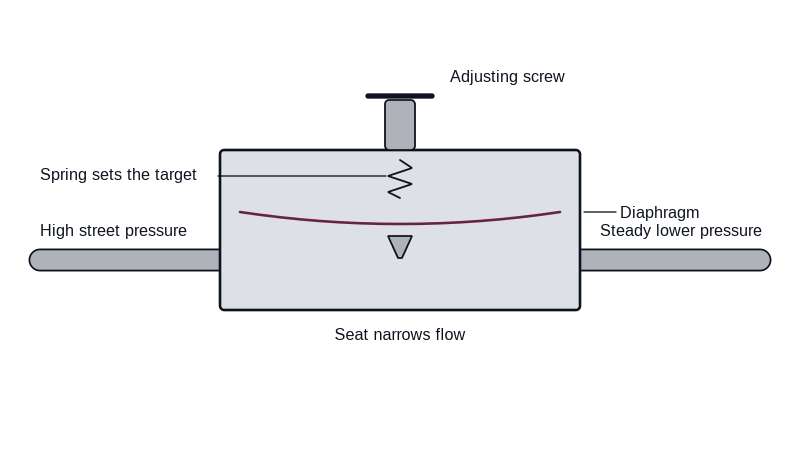
Sometimes labeled a pressure-reducing valve, the regulator is a short brass bell shape set into the main line, normally just past the meter or close to where water comes into the building. It takes high street pressure and holds a steady, lower one inside. When the diaphragm hardens or the seat erodes, it may pass too much pressure or strangle flow.
Clues that one is on its way out:
- Pressure that moves through the day for no obvious reason
- A thud in the walls whenever a valve snaps shut (see water hammer sounds)
- Faucets that begin to weep, or a toilet tank that tops itself up unprompted
- A gauge reading outside the range you expect
To find yours, read about where the regulator sits and what one looks like. Plenty of older homes never had one, and those houses ride whatever the street delivers.
What psi should house water pressure be?
Around 50 psi is a good target. A California water district advises setting a customer-owned regulator near 50 psi and says household plumbing generally sits between 30 and 80 psi. Under 30 you notice thin showers and slow dishwashers. Over 80 you risk dripping faucets and wear on valves and appliance hoses.
A hose-bib gauge, a small screw-on dial from any hardware store, shows you the number. Fit it to an outdoor spigot, switch off everything else, and read it. Check once early morning and once at dinner time, since street pressure moves with demand.
How to read the result:
- Below about 30 psi: low. Hunt for a shut valve, clogged strainer, scaled pipe or a leak.
- 40 to 60 psi: comfortable for most households.
- Above 80 psi: high. A regulator usually fixes it, provided it is sized correctly and set properly. Details sit in the guides on whole-house regulators and on replacing a regulator.
Turning a regulator screw with no gauge on the line can overshoot, so have the plumber show the before and after readings.
What should water pressure be at a 2000 sq ft house?
Aim for the same 40 to 60 psi. House size does not change the target. A larger home needs more flow volume at once, and flow depends on pipe diameter and condition rather than a higher setting. A big house with a weak upstairs shower usually has narrow or scaled pipe, not a pressure shortage.
Pressure is the push; flow is the quantity per minute. Two bathrooms in a house of about 2,000 square feet can demand plenty of flow all at once. Mineral crust inside old steel pipe shrinks the open bore, so the gauge can read well at rest and then collapse when someone starts the dishwasher.
For a bigger home the plumber will usually look at:
- Pressure at rest and while a tap runs, to see how far it sags
- Size and age of the line from the meter
- Whether a regulator is sized to the pipe: a valve smaller than a 3/4 inch line throttles flow (sizing is covered in the guides on three-quarter inch valves and on half-inch ones)
- Scale. USGS says heated hard water leaves calcium carbonate that can clog pipes, and your water supplier lists hardness in its yearly quality report.
Sprinklers are their own case. Irrigation lines often tee off ahead of the house, so a limp zone can come from a plugged head, a failing zone valve, or a regulator sized for the house instead of the yard.
What are the signs of an unreliable plumber?
A bad bid is vague, wants a large payment before any work, resists putting things on paper, or pushes extra work without showing you the fault. California requires a contractor license for larger plumbing work, and the state licensing board's website lets you look up any name or number.
Things to check before anyone opens a wall:
- License. A contractor license is generally needed in California when labor plus materials reach $1,000, or when a permit is involved. Look one up at cslb.ca.gov.
- Deposit. A down payment is capped by law at the smaller of two amounts: $1,000, or 10 percent of the contract price.
- Scope on paper. What is replaced, what is included, what costs extra.
- A measurement first. Be wary of "you need a whole new main" with no gauge reading behind it.
- Old parts. Ask to see what came out.
After you submit the request, a local plumbing business contacts you. Weekdays between 9am and 5pm are when requests get handled. Pricing comes from that business after it has seen the job, so treat any figure on this site as a guide only.
Common questions
What is the cost of a plumber for three hours?
Roughly three times the hourly rate, plus any visit fee. A national cost guide puts plumber rates between $25 and $200 per hour, averaging near $100, and notes that service fees in California run above those in some states. Ask whether the trip charge comes off the final total and whether parts are itemized separately. The actual figure is whatever the plumber writes in the quote.
What are my options when a plumber is out of budget?
Do the safe checks yourself: open the main valve, clean the aerators, run the meter test for leaks. Then request a written quote for the smallest repair that fixes the fault, and ask whether the work can be staged. Renters should report the problem to the landlord in writing, because California habitability rules for rentals cover working plumbing. Gas and main-line work belongs with a contractor.
How do I avoid overpaying a plumber?
Look up the contractor on the CSLB site first, get the scope written down, and keep any deposit within the legal ceiling, which is the lesser of $1,000 and 10 percent of the price. Pay the balance only once you have seen the repair working. For anything involving digging or the main line, get a second opinion.
What happens inside a home pressure regulator?
Inside the brass dome, a spring presses against a diaphragm that is connected to a valve seat. Once downstream pressure rises past the set point, the diaphragm pushes back and narrows the opening. If pressure falls, the spring widens the seat. The target is set with a screw on top. With age the diaphragm stiffens or the seat wears, which means swapping the entire unit.
What is the price of a pressure regulator for a house?
No source we could open gave a firm range, so no number is printed here. Cost shifts with pipe size, how easy the main is to reach, whether a new shutoff valve is needed and local labor rates. Ask for the part and the visit priced together in writing. The page on regulator replacement suggests useful questions.
In this section
- 1 inch water pressure regulator
When a 1 inch water pressure regulator is the right size, how to read your main line, what installation involves and when to bring in a…
- 3/4 pressure regulator
Picking a 3/4 inch pressure regulator for a home water line: where it mounts, how to size and adjust it, symptoms of a failing one and…
- Water pressure and valves
No single regulator suits every house. Size, adjustability, a gauge port and lead-free brass matter more than brand.
- Sudden low water pressure in house
Water pressure dropped suddenly at home? Check for a street problem, a half-closed valve, a failing regulator or a hidden leak, then…
- Water line pressure regulator
A water line pressure regulator sits on your side of the meter and protects pipes and appliances.
- Water main pressure regulator
The pressure regulator on your water main protects pipes and appliances from high street pressure.
- Water pressure regulator 1/2 inch
Half-inch water pressure regulators for Bell homes: what the size means, how to check your pipe, which pressure to target and when a…
- Water pressure regulator 1/4
A quarter-inch pressure regulator fits small lines, not a whole house.
- Water pressure regulator replacement
Water pressure regulator replacement in Bell: test pressure with a gauge, spot a failing valve, understand what a plumber swaps and what…
- Regulator appearance
How to spot a water pressure regulator in your house: its shape, markings and usual location, what it is not, and what to do if you cannot…
- Water pressure and valves
Where is the water pressure regulator in a house?
- Whole house water pressure regulator
What a whole-house water pressure regulator does, where it sits, signs it is failing, how replacement works and what to ask a plumber in…