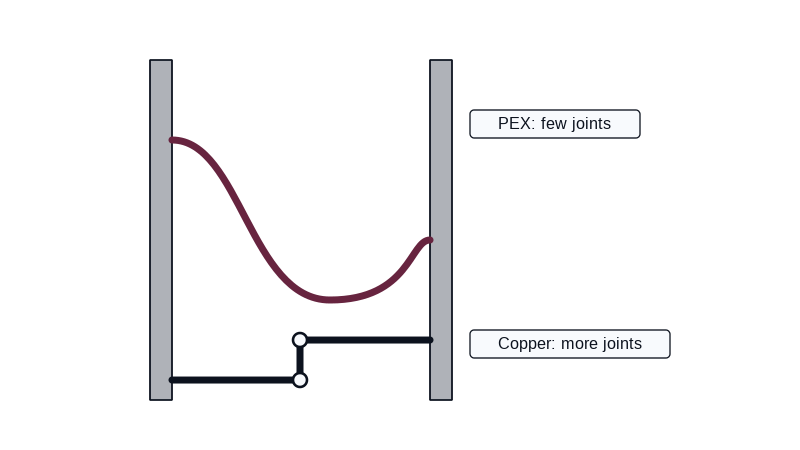
Neither material is the villain. PEX is cheaper and easier to thread through a finished house, while copper offers the longer history and ignores sunlight and rodents. Inside a Bell bungalow with plaster walls, the real question is often how many holes each choice requires. The whole-house job itself starts at repiping a house. Once you want figures for your own home, the quote form arranges a visit, and the Slauson Plumbing home page lists other jobs we handle.
What separates PEX from copper in a direct comparison?
PEX is cheaper by the foot, turns corners with few joints and is less likely to burst when water freezes. Copper is pricier, uses soldered or pressed fittings, and sunlight has no effect on it. California approves both for homes, and either can serve for decades given suitable water and a sound installation.
| PEX | Copper | |
|---|---|---|
| Material price, per foot of pipe | $0.40 to $2 | $2 to $8 |
| Quoted lifespan | Roughly 80 to 100 years | Roughly 50 to 100 years |
| Flexible, few joints | Yes | No, rigid with many fittings |
| Sunlight | Degrades quickly outdoors | Unaffected |
| Rodents | Can be chewed | Resistant |
| Corrosion | Does not corrode | Can pit or pinhole over time |
The price and lifespan rows come from Bob Vila's national survey. The sunlight, freeze and chlorine points come from Wikipedia's PEX article.
How do PEX and copper differ on price?
One national guide gives $1,500 to $15,000 for repiping a whole house, averaging close to $7,500, and $2,280 to $5,120 for a three-bedroom house of 1,500 square feet. Labor, wall repair and permits make up most of that, not the pipe. Copper lifts the total since each foot is dearer and fitting it is slower.
The material gap is real yet smaller than most expect, because a few hundred feet at $2 against $6 amounts to hundreds of dollars. Labor settles the remainder. Look for a quote stating whether it covers the whole house, how many walls open, who repairs the drywall and whether the permit fee is counted. Only the plumber's written number counts; the guide figures are for orientation.
Does PEX or copper have the longer life?
Figures are close: the same national survey gives about 80 to 100 years for PEX and 50 to 100 for copper. In practice, water quality and workmanship decide. PEX resists chlorine and scale. Copper can pinhole, and Wikipedia notes pinholes can form from stray electrical current when copper pipe is badly grounded or bonded, which is a wiring fault rather than a plumbing one.
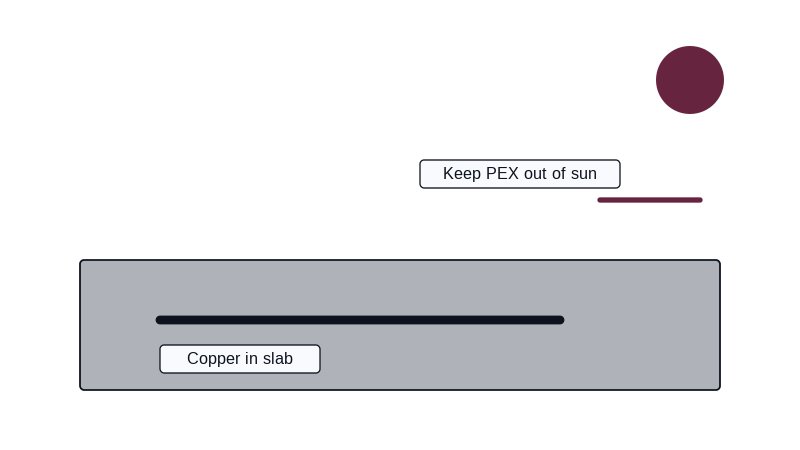
Sunlight is the one clear PEX limit: left exposed, it degrades fairly quickly, so it stays inside walls, attics and under floors. Copper laid in or under a slab can react with the concrete over a long period, which is one reason slab leaks show up in older copper homes.
Which pipe copes better with cold weather?
Frozen pipes are uncommon near Bell, yet the answer holds anywhere: PEX tolerates a freeze better. Flexibility lets it resist bursting once the water inside becomes ice, whereas rigid copper tends to split. Neither is a reason to choose a material for this area on its own, and any exposed run, whichever pipe it is, benefits from insulation.
How does flow compare between half-inch PEX and half-inch copper?
Nominal sizes do not equal inside diameters. Tubing labeled PEX in a given size usually has a slightly narrower opening than copper carrying that same label, and PEX fittings may squeeze it more. For that reason plumbers frequently choose the next size up on long PEX runs or main trunk lines. Flow in a normal house is rarely the deciding factor; branch layout and supply pressure matter more.
Which suits an old house or a mobile home?
For a 1920s to 1950s Gateway-city bungalow, PEX is usually easier, because the plumber can fish flexible tubing through walls and crawl spaces and cut fewer openings in plaster. Aging galvanized steel is the usual trigger for repiping these homes; the signs are covered under galvanized pipe replacement.
Mobile and manufactured homes frequently get PEX. The Bob Vila survey gives $1,500 to $4,000 for repiping one. The flexible tubing runs under the floor easily, though rodents chew it, so the underside needs to be sealed.
Does PEX or copper change the water you drink?
Copper does not release harmful chemicals into drinking water, according to the same survey. PEX is chlorine-resistant and does not corrode. A plumber can explain the fittings in either case: PEX is joined with crimp rings or clamps and the specialised tool they need, copper with solder or pressed joints. Gas piping is another matter. It needs a contractor license and usually a permit.
Which questions belong in a repipe booking?
Find out the planned material and the reason, how the water heater connections will be handled, whether walls get cut or the work runs through the attic, and if the permit is in the price. The state's contractor-license threshold is $1,000 of labor and materials, and permitted work needs a license regardless.
Staff read forms on weekdays from nine to five. Submit the details and a local plumbing business able to quote the job will be found.
Common questions
Is PEX cheaper than copper to install?
Usually, yes. PEX pipe runs $0.40 to $2 for each foot while copper costs $2 to $8, and it goes in faster because it bends and needs fewer fittings. On a whole house, the saving is mostly labor. The difference narrows if walls are being rebuilt anyway.
Is it fine to combine PEX and copper in a single house?
Yes, and the practice is widespread. A plumber can connect PEX to existing copper with transition fittings, which lets a repair or a partial repipe leave the sound copper in place. Ask the plumber which connections will be exposed and how they will be supported, since mixing metals and plastic needs the right fitting for each joint.
Does PEX leach anything into drinking water?
According to a national guide, PEX is corrosion-free and stands up to chlorine and scale. Some people notice a taste in new plastic lines, and flushing the system after installation is standard. If water quality worries you, ask for the pipe's drinking-water certification markings and check the manufacturer's information; this page cannot judge a specific product.
Why do older houses have pinhole leaks in copper?
Pinholes come from corrosion, and one documented cause is stray electrical current from copper pipe that is badly grounded or bonded. One or two can be patched. Many across a house suggest worn-out pipe, in which case pricing a repipe makes sense. A plumber can test the grounding as part of the visit.