Nobody publishes a tidy national price list for commercial plumbing. What exists is the residential hourly spread, plus a plain statement from Fixr that business work "usually costs more". Running a cafe in Huntington Park or a workshop by the Vernon rail yards? Start with the quote form; a plumber based nearby then arranges to see your premises. Slauson Plumbing arranges the visit; every dollar figure here is a benchmark, not our quote.
What does an hour of plumbing actually run?
Fixr's national average is $90 an hour, inside a $75 to $150 centre and a $45 to $200 outer edge. Over at This Old House the figure is near $100 hourly, with a trip charge or minimum on top and a floor of $25. Business premises typically fall in the upper half of such ranges.
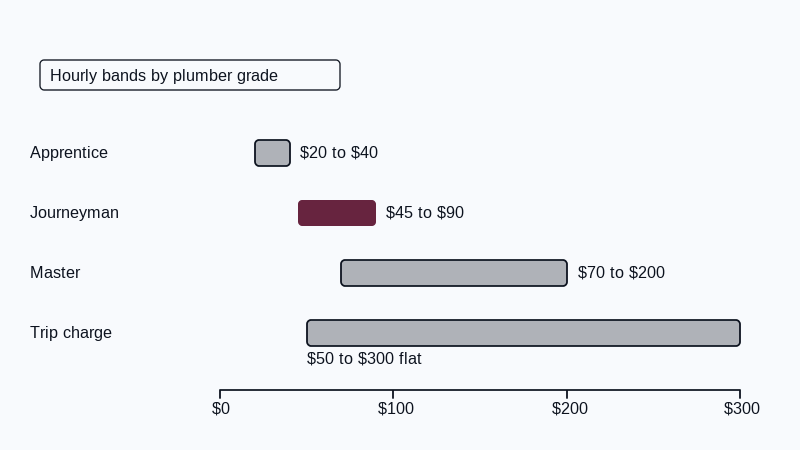
Skill grade moves the figure more than the sign on the van door:
| Grade of plumber | Fixr guide, per hour |
|---|---|
| Master | $70 to $200 |
| Journeyman | $45 to $90 |
| Apprentice | $20 to $40 |
| Trip or service charge (flat) | $50 to $300 |
Fixr does not print a separate commercial number, so be wary of a website that does. Articles quoting rates from 2018 to 2022 are stale as well, since fuel, insurance and wages have all shifted.
Why do shop and warehouse jobs run higher than a house visit?
Larger pipe, more fixtures, tight windows for shutting water off and heavier liability all stretch either the hours or the grade of plumber needed. A rooftop riser, a grease interceptor or a row of restrooms takes longer to isolate than one kitchen faucet, so the bill grows on both axes.
Our corner of Los Angeles County shows the contrast. Wikipedia describes Vernon as exclusively industrial: 222 residents in 2020 but roughly 46,000 people working there, in food plants, metal shops, meatpacking and warehouses. Commerce was incorporated in 1960 to hold on to its industrial land. A plumber in those buildings handles pipework that has nothing in common with a 1940s bungalow.
Things that lift the hourly figure or the hours:
- Line diameter. Heavier tools, sometimes a second person.
- Shutoff windows. Tenants who cannot lose water at noon push the job to evenings or weekends, which is premium time.
- Testable devices. Business plumbing more often carries backflow assemblies; read our backflow testing guide.
- Reach. Roof hatches, ceiling voids, mezzanines and landlord keys eat minutes.
- Hardware. Commercial-grade valves cost more than retail ones.
- Second trips. A trip charge can come around again if parts are missing.
How do the hours add up to a final bill?
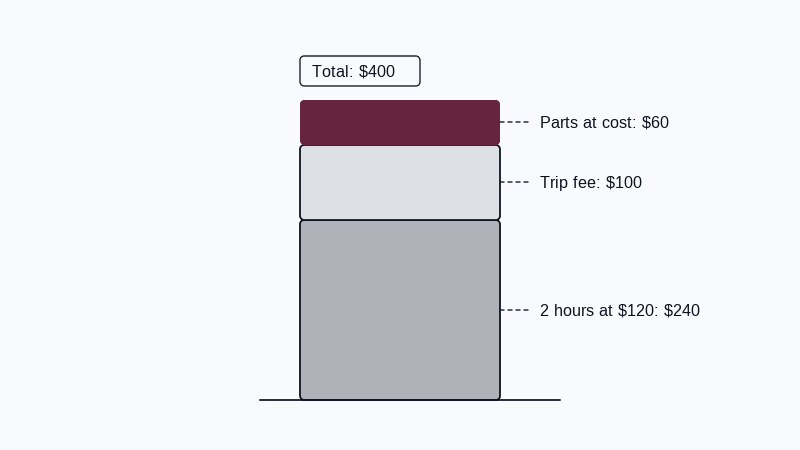
Multiply hours by rate, then layer on the trip charge, parts, permits and disposal. Say the plumber needs two hours at $120, plus a $100 trip fee and $60 of parts: that is $400. Ask whether time is billed in blocks, because a one-hour minimum changes small jobs a lot.
Write it as a short sum on paper before you accept anything:
- Hours the plumber expects, multiplied by the rate.
- The trip fee, once.
- Parts at the plumber's cost to you, not shelf price.
- Permit and dump fees, where they apply.
- A named cushion for surprises, if the quote has one.
A flat figure shields you when a defined job overruns. An hourly basis fits a fault nobody has diagnosed, since the plumber must open things up before anyone knows the answer. For the household version of the sum, the plumber hourly guide works through examples.
What does out-of-hours commercial plumbing cost?
After-hours work is dearer. Fixr's emergency benchmark is about $150 per hour, plus a flat urgent charge of $200 to $300 and, on some jobs, $50 to $200 for travel. A split line in a closed unit on a Saturday lands at the expensive end, so closing the valve first keeps the total down.
In a shared building with several tenants, the supply riser and shared drains usually belong to the landlord, so tell them early. The emergency plumbing page lists the first steps. We read what comes in through the form on working weekdays, nine to five. Nights are not covered.
What should the paperwork say before a commercial job starts?
The scope, the rate or flat price, the trip fee, parts, permit costs, access assumptions and what changes the price. For work totalling a thousand dollars or more, California wants a contractor license held by whoever does it, and permit jobs need one whatever they cost. Ask for the number early.
Details that make a quote trustworthy:
- Which person's rate is being charged, and what grade are they?
- Is the trip charge deducted if you go ahead?
- Permit: whose job is the application, and what does it add?
- How large is the deposit? The state caps deposits at ten percent of the price or $1,000, whichever sum is smaller.
- What is excluded: wall patching, paint, return visits after hours?
Set two or three quotes beside each other on identical scope. A bid way below its rivals needs a close read for what has been left out.
Common questions
Which hourly figure should I expect to see?
Nationally Fixr averages $90 hourly, within a $75 to $150 centre and a $45 to $200 full spread, while This Old House lands near $100 before fees. Los Angeles County can price above any national average, so the local written figure is what matters.
How do master plumber and journeyman rates compare?
Fixr shows journeymen at $45 to $90 an hour and masters at $70 to $200. The master rate pays for judgement on complicated or risky work, such as large commercial mains, while a journeyman suits routine repairs. Ask who is actually coming and what rate applies.
Is a flat price cheaper than paying by the hour?
Sometimes. Fixr's examples include a flat $400 for a water heater installation, $150 to clear a drain and $120 to replace a toilet. Flat suits a clear task, hourly suits a mystery fault. Either way, insist on seeing the price in black and white before any tools come out.
Why would business plumbing cost more than a home job?
Fixr says commercial work usually costs more without printing a number. The usual reasons are bigger systems, scheduling around trading hours, more fixtures, permits, testing and liability. A good quote lists each of these as its own line, which shows exactly where the extra goes.
Does the trip charge get credited against the repair?
That depends on the business. In Fixr's guide the service call runs from $50 up to $300, journeymen low and masters high. Some plumbers credit it when you proceed and others do not. Raise the point before the visit and see that the written quote states the answer.