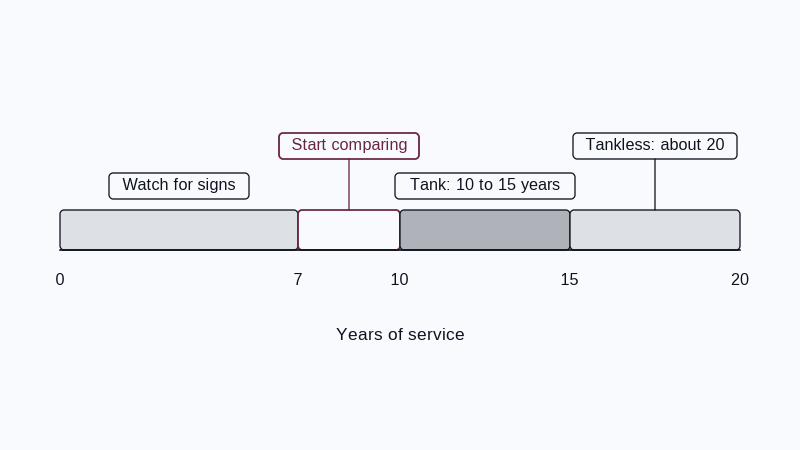
Plan on replacing a storage tank water heater every 10 to 15 years, and a tankless unit after roughly 20 provided it was flushed regularly, according to Department of Energy guidance. The calendar is only half of it. A heater that leaks, rusts or rumbles needs attention sooner, and one past seven years old is worth watching. Most upkeep and swap-outs sit under water heater repairs and services, which a local plumber carries out.
Think of the age on the sticker as an early-warning light, not a deadline. Water chemistry and upkeep across the United States decide more than the date does.
How many years does a water heater last?
Department of Energy figures give a conventional tank heater roughly 10 to 15 years, while tankless units may run beyond 20. Gas and electric tanks fall in the same band. Actual life swings either way with water hardness, flushing frequency and whether anyone ever inspected the anode rod.
Tankless units last longer partly because no standing water sits inside to corrode them. Even so, scale on the heat exchanger can choke flow and cut life short, so the manufacturer's flush schedule counts. Find the serial number on the data plate, since most brands encode the build month and year there, and a plumber can decode it if the label confuses you.
When should you start shopping for a new heater?
Start comparing options when the tank is about seven years old, or sooner if it has symptoms. Researching before it fails gives you time to pick a size, compare fuel types and get written prices, instead of choosing in a rush with a flooded garage. The Department of Energy gives this seven-year mark as the point to begin.
A planned replacement costs less in stress, and often less in dollars, than an emergency swap. National price ranges appear on the water heater replacement cost page, and you can decide between tank and tankless using tank vs tankless water heaters.
What signs say a water heater is near the end?
Choose replacement over repair when you notice a puddle at the base, rusty hot water, rumbling or popping from sediment, repeated pilot or element failures, or hot water that runs out much sooner than before. Leakage from the tank body is the clearest signal, as a corroded tank shell cannot be mended.
Contrast that with fixable faults: a bad thermostat, element, thermocouple or relief valve can be swapped on a heater that is healthy otherwise. When no hot water arrives at all, read why you have no hot water before concluding the unit is dead.
What is the right interval for anode rod replacement?
No single interval applies. Many manufacturers suggest inspecting the anode rod every few years and replacing it once it is mostly consumed, since the rod corrodes instead of the tank steel. Consult the manual for your model. Hard water, softened water and warm settings can all wear a rod faster than average.
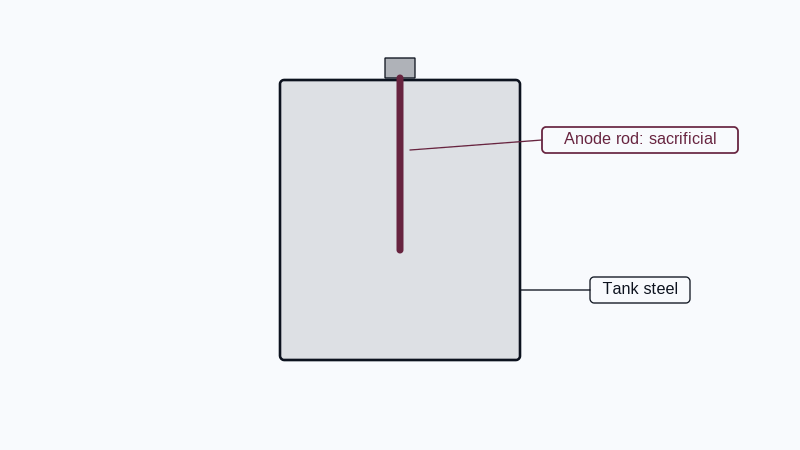
A worn rod does not announce itself; the tank just starts to rust sooner. If your heater is already ten years old and the rod has never been checked, replacement of the whole unit is often the more sensible spend. More detail is in the anode rod replacement guide.
Does local hard water shorten a water heater's life?
Yes, heating hard water builds calcium carbonate deposits that can shorten equipment life, raise heating costs and clog pipes, according to the U.S. Geological Survey. In the USGS scale, 121 to 180 mg/L counts as hard. Commerce's water system averaged about 146 ppm in its 2025 report, which makes scale a realistic concern there.
Your own figure depends on your supplier: some Gateway cities have several providers, even within one city, so read the annual water quality report from the provider named on your bill. A neighbor's figure may not apply. Draining a tank once a year and watching for sediment at the drain valve helps in hard areas, and hard water scale prevention covers what else works.
Who can replace a water heater, and is a permit needed?
California treats replacement as work for a contractor with the state license, and your city building office generally expects a permit. The state requires a license for any job reaching $1,000 in labor and materials, and always when a permit is needed. Gas heaters involve gas piping and venting, which are regulated work and not DIY.
Permit offices differ: Bell's building and safety division is at City Hall, 6330 Pine Avenue, and other cities among the areas we cover list their own. Ask the contractor who applies for the permit and when the inspection takes place. Should you smell gas, exit the building, report it to your gas utility from outside, and use 911 if you feel endangered.
When you want help, fill in the quote form with the heater's age and type. Other services are on the Slauson Plumbing home page.
Common questions
Does repairing an old water heater cost less than replacing it?
Beyond about 10 years, or when the tank itself leaks, replacement usually wins. A repair on a young heater, such as a new thermostat or element, costs far less than a unit. Ask for both prices in writing so the comparison is honest, and ask what each choice leaves you with.
What shortens a water heater's lifespan the most?
Sediment from hard water, skipped flushes, a worn anode rod, high temperature settings, and high water pressure all wear a tank down. Corrosion eventually perforates the steel. Regular draining and an occasional anode check slow it, but no maintenance makes a tank last forever.
Can a tankless water heater really last 20 years?
It can, with care. Department of Energy guidance puts tankless life at more than 20 years, against 10 to 15 for tanks. That depends on flushing the heat exchanger, especially in hard water areas, because scale restricts flow. Skipped maintenance can cut the number sharply.
Should I set the thermostat lower to extend life?
A lower setting reduces mineral buildup and scalding risk. At 140 degrees Fahrenheit skin can burn in less than five seconds, which is why many households pick a lower setpoint. Check your manual, and ask a plumber to adjust a gas control or element thermostat rather than guess.