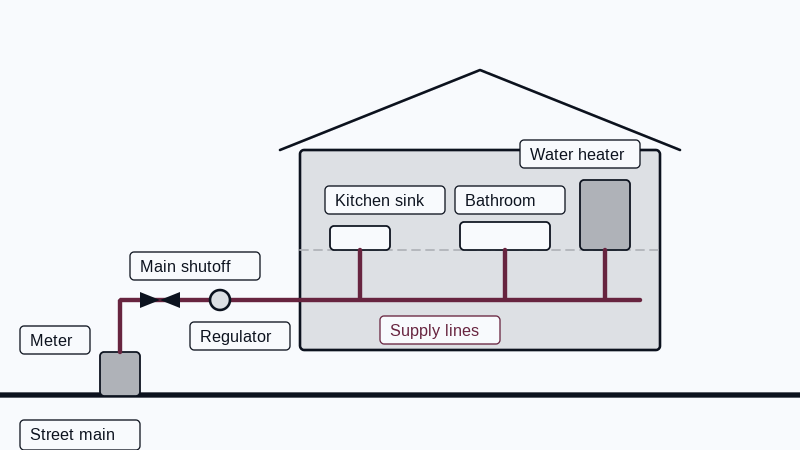
Picture a 1940s Bell bungalow where the kitchen supply line springs a pinhole, gets patched, and three months later the bathroom one goes. That pattern is what a repipe is for: tearing out the old hot and cold lines and running new ones, mostly in PEX or copper, instead of chasing leaks one by one. The quote form is step one; we then set up a visit by someone local. More about us is on the Slauson Plumbing home page.
What is considered a repipe?
A repipe means renewing the pressurized supply system that feeds every faucet, shower, appliance and the water heater, in whole or in large part. Mending a single leaking stretch does not qualify, however messy the leak was. Waste lines belong to a different system with a separate price tag.
Most jobs follow the same arc:
- Water goes off and the lines are emptied.
- Small openings are cut in drywall, or the plumber works from the attic or crawlspace if there is one.
- New tubing is run to each fixture and connected.
- A pressure test comes first; wall repair follows.
The step-by-step repiping process gets its own walkthrough.
When is replumbing a house the right call?
Look hard at a repipe when leaks keep appearing in new places, taps run rust-brown, pressure sags even after valves are replaced, or the tubing is a type with a known failure history. Around Los Angeles that usually means old galvanized steel or the grey plastic known as polybutylene.
Galvanized steel is the usual suspect in the bungalows and small tract homes of the mid-century. Wikipedia notes it corrodes internally, with deposits slowly choking the bore. Pressure fades long before anything bursts. Signs to watch for appear in our piece on swapping out galvanized pipe.
Poly-B filled millions of homes on this continent from about 1978 to 1997. Municipal chlorine slowly eats the plastic from within, so sound-looking pipe can still split without warning. The same reference calls total replacement the only durable fix. Specifics are under polybutylene pipe replacement.
Copper sits in between. It often outlasts everything else, yet it can pit and pinhole. One pinhole means a patch. A scattering of them throughout the house argues for starting fresh. Longer reasoning sits in reasons to repipe and the repiping interval.
Which pipes does a plumber actually replace?
Plumbing in a house splits three ways. Pressurized supply lines are one, waste and vent piping another, and gas lines, if the home has gas, a third. A repipe touches only the first. A fair quote says so, notes whether the underground pipe from the street meter to your wall is part of it, and lists the exclusions.
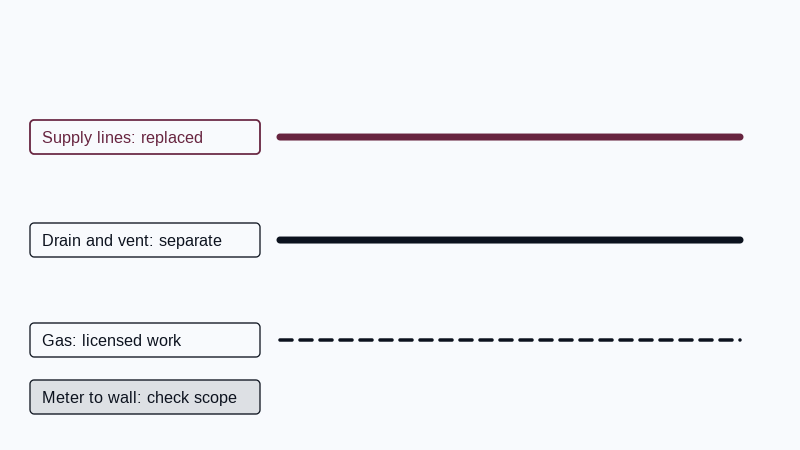
Gas lines are regulated: a contractor license applies, usually with a permit, so nobody should slip them in as a favour.
Supply tubing choices, with per-foot prices from Bob Vila's survey:
- PEX. Bends around corners with few joints. The survey puts it near forty cents up to two dollars per linear foot, with a lifespan of 80 to 100 years. Sunlight ruins it, so it stays inside.- Copper. Runs from two dollars to eight per linear foot, with 50 to 100 years quoted. More expensive in labor as well as materials.
- CPVC. A budget plastic, about 50 cents to $1 per foot, rated 50 to 70 years.
Our write-up on PEX versus copper sorts out which suits what.
What will it cost to repipe?
Bob Vila's survey lands on about $7,500 on average, though single jobs range anywhere between fifteen hundred and fifteen thousand dollars. A 1,500 sq ft, three-bedroom house is cited somewhere from $2,280 through $5,120; a manufactured home runs $1,500 to $4,000. Local prices differ, and only a written quote counts.
Add drywall repair if walls open up: the same guide quotes $45 to $90 per square foot for ceilings. Line items are itemised under what a repipe costs.
What nudges the number up:
- two floors, or a long underground run from the meter
- a slab foundation, where lines may need rerouting overhead
- finished plaster or tile that must be restored
- the city permit and inspection fees
- copper instead of PEX
Access matters. A crawlspace beneath the floor lets a plumber work with few openings. A slab house often means going through the attic. Know which one you have before comparing bids.
Will the water be off for days?
Plan on several working days for a standard house, more with two stories or finished walls. Water is interrupted during working hours, so arrange a place to cook and wash, and expect some dust. After the walk-through, ask the plumber to give you a schedule on paper.
Is it worth the money? Weigh it against what you will otherwise spend: repeat repairs, ruined floors and a house that is hard to sell. Failing pipes in several rooms usually cost less to replace outright than to fix a third and fourth time. A single bad branch may justify only a partial job.
Can you do your own plumbing in California?
Some homeowners handle plumbing in their own house, but this job is heavy and the city expects a permit plus an inspection. Anyone you pay needs a state contractor license when the total hits $1,000, and regardless of price when a permit is involved.
Check with the city building office before touching anything. Bell issues permits through Building and Safety, in City Hall; adjoining cities have separate counters. Leave gas lines alone entirely. Supply-line mistakes tend to surface later as leaks inside walls, the costliest place to find them.
Common questions
Can a handyman do basic plumbing?
A handyman can change a faucet cartridge or a braided supply hose. State licensing rules apply once labor plus parts reach $1,000, and to any permit job. A repipe sails past that line, so hire a contractor and request the license number.
Is setting a toilet a job for a non-professional?
Plenty of owners set their own toilet over a weekend when the floor flange and shutoff are sound. Doing it for pay is another matter once the job crosses the license threshold. Check the condition first with our guide to a leaking toilet.
Do galvanized pipes always mean a repipe?
No. Galvanized lines that still give strong pressure and clear water can keep going for a time. They do corrode inside, though, so rust-coloured water, weak flow or leaks in several spots point to replacement. Get a written price, and bring up partial replacement as an alternative.
Which method is best for repiping?
The best way suits your house: PEX through crawlspace or attic where access is easy, as few wall openings as possible, and a pressure test before any wall is closed. Copper is the pick if you prefer it. Have each plumber describe routing and patching in writing.
Can piping run through the attic?
Often, yes. In a slab house, new lines can travel overhead and drop inside walls, saving the concrete. Whether that works depends on roof space and wall layout. Have the plumber mark the planned route on your own floor plan.
In this section
- Galvanized pipe replacement
Galvanized pipe replacement in Bell homes: signs the steel is failing, replacement options, permit and timing questions, plus the…
- Polybutylene pipe replacement
Polybutylene pipe replacement for Bell homes: how to tell if you have it, why it fails, what replacement involves, permits, and how to…
- Repiping and pipe replacement
Pipes are not replaced on a calendar. See how long copper, galvanized, PEX and polybutylene last, the warning signs that matter, and what…
- Repiping and pipe replacement
How a whole-house repipe works from first walkthrough to final pressure test, including PEX, slab foundations, permits and what it costs.
- Repiping and pipe replacement
PEX or copper for a Bell home? Compare cost per foot, lifespan, flow, cold weather and older houses, with national price figures and what…
- Costs
What repiping a house costs: national price ranges by home size and pipe material, what moves the number up or down, and how to compare…
- Repiping and pipe replacement
Why do owners in Bell and nearby cities repipe a house?