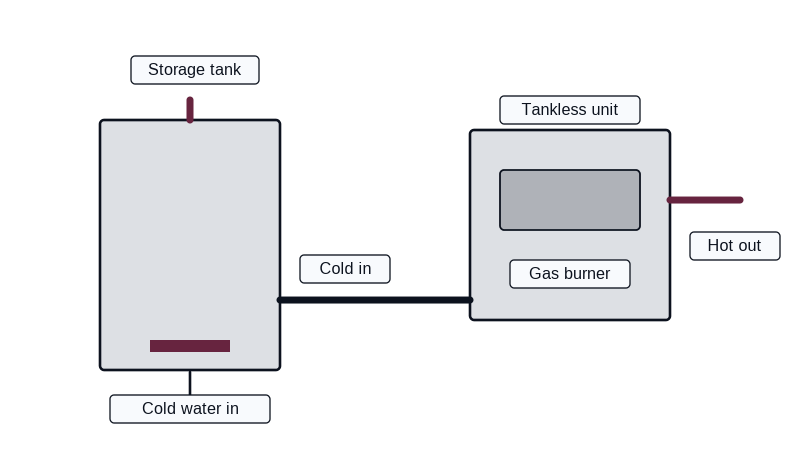
A tank fits when money is tight, the closet already suits one and many people share the hot water. Tankless fits if you plan to stay about a decade, use hot water in brief spurts, and have a gas supply and vent route able to take it. Numbers below come from published guides. Broken heater instead? See water heater repair in Bell.
When does a faulty heater deserve a repair rather than a new unit?
Repair when a single inexpensive part has failed on a fairly young heater: a thermostat, element, valve or igniter, for instance. Replace it when water is escaping from the tank body, or when an aging unit keeps needing one repair after another. Steel shells that corrode through cannot be patched.
A simple test sets the repair quote against a fraction of a new unit. When one repair costs over a third of replacement and the heater is past its prime, most people replace. If you are weighing tank against tankless at that moment, get the plumber to quote both, so you see the true gap for your house rather than a national average.
Is a tank or a tankless heater cheaper?
Tanks cost less to install. Published guides put a typical tank installation at roughly $800 to $2,500 and a tankless installation at $2,500 to $4,500. Treat those figures as a national guide, not a quote from us: the plumber who visits sets the real price after seeing your gas line, vent and access.
The gap comes from the unit itself and from the work around it. A tankless heater is a more complex appliance, and a house built for a tank frequently requires a wider gas line, a fresh vent path and sometimes a condensate drain. This Old House gives its own pair of numbers, $1,200 to $2,300 for a tank and $2,100 to $4,000 for tankless, so the two sources differ by a few hundred dollars either way.
| Item | Guide range | What moves it |
|---|---|---|
| Tank install, gas or electric | $800 to $2,500 | Size, venting, permit, removal of old unit |
| Tankless install | $2,500 to $4,500 | Gas line size, vent type, panel upgrade for electric |
| Extra gas line, when required | up to about $800 | Distance from the meter, wall and floor access |
| Permit and inspection | $50 to $200 | The city building office sets its own fee |
How much will each one cost to run?
Light users gain the most from tankless. Federal energy guidance credits on-demand heaters with a 24 to 34 percent efficiency edge over storage tanks, but only where daily hot water stays at or below 41 gallons. Heavier use shrinks that edge to a fraction.
Fixr's guide estimates gas tankless at about $250 a year against about $275 for a gas tank, and electric tankless at about $600 against about $450 for an electric tank. That is the quiet catch: an electric tankless unit can cost more to run than an electric tank, so the savings story applies mainly to gas.
Some Bell and Bell Gardens households are large, with several adults and children sharing one bathroom block in a duplex. There, one tankless unit can run short of capacity if a dishwasher and two showers are going at once. A handy rule: total the flow of every fixture you use simultaneously, then check that the flow rating of the unit, measured at your incoming water temperature, is high enough to cover that total.
What is the difference between gas and electric tankless heaters?
Gas tankless heaters heat water faster and handle higher flow, but they need a large gas supply and a vent to the outside. Electric tankless heaters need no vent yet pull heavy power, often requiring dedicated circuits or a panel upgrade. In older homes with small panels, the electric route can cost more than the heater itself.
Equipment prices in Fixr's guide run from about $250 to $2,000 for gas and $200 to $1,500 for electric, depending on flow rating. Either way, gas appliances and their piping belong with a contractor holding a California contractor license, and a heater swap generally needs a permit pulled through the city building office. Ask who will obtain it. A line-by-line breakdown sits on the page about what replacement costs.
Does a propane or mini tank change the answer?
Propane units work much like natural gas ones, but the fuel costs differ and the appliance has to be rated for propane. Most dense Bell and Bell Gardens streets have natural gas service, so propane comes up mainly for outbuildings, a few units behind a house, or a converted garage. A mini tank, usually a 2.5 to 10 gallon electric heater, suits one sink or one bathroom, not a whole home.
For a backyard ADU or a converted garage, a small electric tank or a point-of-use tankless unit is often the practical choice, because it avoids running a new gas line. Whether you can have one there depends on the permit for the structure, so check with the city before buying.
Can you replace a tank heater with tankless in an older home?
You can, and many homes in this area do it, but expect extra work. Bungalows and small tract homes built between the 1920s and 1950s usually carry half-inch gas lines sized for a stove plus a tank heater. Tankless may want a three-quarter inch line, new venting, and wall space with proper clearance. Our guide to gas tankless water heater installation covers the parts.
Also confirm the water side. Minerals in the supply bake onto a tankless unit's internal coil as scale, which is why makers call for periodic flushing. Your water company's annual quality report lists hardness, which tells you what the coil will face.
How do tank and tankless totals compare after ten years?
Across a decade, a tankless heater can recover part of its higher price via lower energy use and longer service life, though only in a suitable house. If a tankless unit costs $1,500 more to install and saves $25 to $100 a year, the payback is longer than most people stay, so the case rests on lifespan and convenience rather than savings alone.
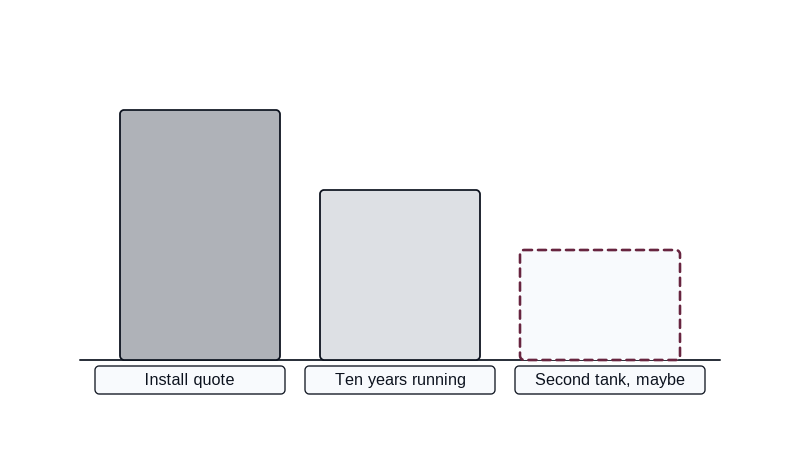
Use this thinking in place of a calculator. Total each installed quote, add ten years of running cost from the figures above, and include a second tank purchase if the first may fail before then. For lifespan advice, see when a water heater is due for replacement. If the numbers land within a few hundred dollars, choose on comfort and space.
Common questions
Does a small household benefit from tankless?
Often, yes, if you use gas. One or two people running a shower and a sink usually stay inside the unit's flow rating, and you stop paying to keep a full tank hot all day. If you rent out a duplex with several tenants, the maths changes: a tank is cheaper to buy and easier to replace.
Is it possible to exhaust a tankless heater?
Not the way a tank empties, because heating continues as long as water flows. The limit is flow rate: open too many outlets and the unit cannot lift all that water to temperature, so everything runs lukewarm. Choosing the size by your busiest morning, not an average day, prevents it.
Is upkeep needed for a tankless unit?
Yes. Minerals build up as scale inside the heat exchanger, which is why the unit usually wants a vinegar or descaling flush on the maker's timetable, commonly once a year in hard-water areas. Neglecting that flush shortens its life and can trigger error codes. A tank needs less attention, though its anode rod and drain valve still need checking.
Is a permit needed to go from tank to tankless?
The plumber normally handles it. A conversion like this, plus any gas line change, usually goes through the building office of your own city, while unincorporated East Los Angeles goes through the county. Anything needing a permit must be done by a contractor who holds a California license.
What should I ask the plumber before signing?
Ask what gas pipe diameter the tankless model demands and whether yours must be enlarged, where the exhaust will exit, and whether permit fees are included in the price. Get a tank price and a tankless price on paper together, so the gap is visible before you commit.
Need real figures for your house? Submit the quote form and say which type you lean toward. Other services are listed on the Slauson Plumbing home page.