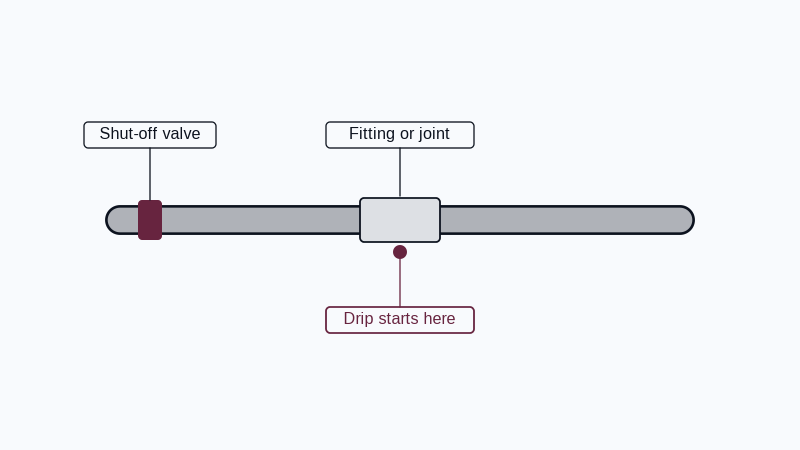
Water coming from plastic pipe almost always starts at a joint. So the first move is to close the valve, mop up, and watch where the next bead of water forms. A joint repair is cheap, a wall full of wet insulation is not. If the leak is hidden or you can't shut it off, hand it to a plumber. The Slauson Plumbing home page lists the jobs we line up around Bell.
What is the first step when plastic pipe leaks?
Close the nearest shut-off valve, or the street-side main when no other valve turns, then open the lowest tap indoors to empty the line. Wipe the pipe dry. Within a minute or two the damp spot returns at the real source, be it a fitting, a crack or a rub mark.
Check the fitting first, then the first few inches of pipe beside it, then any place the pipe touches a stud or another line. Running a dry paper towel along the pipe reveals a slow weep your eyes miss.
A rubber patch plus a clamp, or self-fusing tape, will last an evening. Treat either as a bandage. Photograph the printed lettering on the pipe before you drive to the store, because that print says what material you have and the new part must match it.
The loss adds up: according to the EPA, the average household wastes over 9,300 gallons a year through leaks. Damage you cannot reach is covered in leaking water pipe repair.
How can a leaking tap be stopped?
Close the little valve beneath the sink, take the handle apart and replace the worn part. Water at the spout usually means a washer, O-ring or cartridge has given out. Water around the base points to an O-ring or seat, and water in the cabinet below often just needs a snugged supply nut.
The EPA says one drip a second wastes more than 3,000 gallons a year, and a showerhead dripping 10 times a minute loses over 500. Small drips are worth the half hour.
Older compression taps press a rubber washer onto a seat, and both wear out. Cartridge taps lift out as one assembled unit. Bring the old piece to the store and match it by eye. A stuck handle, heavy corrosion or a leak inside the wall behind the fixture are plumber jobs. Cabinet connections are covered in fixing a leaking pipe under the sink.
How can I avoid overpaying a plumber?
Request a written scope listing parts and the total before work begins, and verify the contractor's license on the state site. A deposit in California is limited to $1,000 or 10 percent of the contract price, whichever is less, so a large cash demand up front is a warning sign.
Ask what the number contains: permit, wall patching, hauling and clean-up. A single lump sum is hard to compare. Line up two or three bids against identical items instead of taking the cheapest.
Back away when a plumber won't put anything on paper, insists you sign at the door or announces a same-day deadline with no reason given. A straight contractor can explain the finding and hold up the failed part.
Where do I find a local plumber in Bell?
Use the quote form to describe the job, and a local plumbing business that we pass it to comes out to you. Staff read requests Monday to Friday, 9am to 5pm. Gather the pipe material if known, the leak location, whether the shut-off turns, and a few photos.
Price follows access. Replacing a fitting on exposed pipe is small. A leak inside a slab or wall costs more because of opening and patching. Treat any online figure as a guide only, and request the price in writing.
Some contractors advertise heating and air conditioning alongside plumbing, so confirm the plumbing classification appears on their state record. A map app listing proves nothing about a contractor, so check the license on the state board's website.
What is plumbing like in a manufactured home?
A factory fits the pipes in each floor section of a manufactured home, and the last connections are made on site after the sections are joined. Supply lines usually run through the floor or walls and drains sit below, so repairs follow the same logic as any house.
New plumbing beneath a mobile home is fresh work, not a patch. It needs the right pipe type, proper supports and probably a permit and a contractor. Lines under the floor face weather and animals, so protection counts. Ask the plumber which material and supports are planned. Details are in plumbing beneath a mobile home.
What if the leaking plastic pipe is outdoors?
Turn off the supply feeding that run, drain it and let it dry. Outdoor plastic leaks most often at a sun-cracked fitting, a split through the pipe wall or a joint never fully bonded. A hose or sprinkler line often needs nothing more than a new coupling.
Sunlight is the main culprit. PEX degrades quickly in the sun, and as few as 30 days of direct exposure may leave it brittle, so uncovered PEX outside needs shielding or a new covered section. PVC left in the sun chalks and then cracks.
For a small split on a cold line, cut out the damaged piece square, clean the ends and slide on a matching repair coupling. Stop there if the pipe disappears into a wall or if the soil stays soggy with everything turned off. That pattern suggests a buried leak, and the signs are listed in telling whether a pipe burst.
What does replacing plumbing in an older house involve?
Settle the order first, since opening walls is the biggest cost in an older house. Bell houses dating from the 1920s into the 1950s often still carry original galvanized steel or aged copper. Ask the plumber to test pressure and flow before you decide how much to replace.
Tight budget? Stage it: the main line, then kitchen and bathroom branches, then the rest. Partial work can leave corroded sections that fail next, so get the plan in writing with each branch named.
A contractor license is required in California once labor and materials together reach $1,000, and for every permitted job, which includes a repipe. Bell issues the permit through the Building and Safety counter at City Hall, and applications can be emailed. The full process sits on repipe house.
Is replacement always needed for a broken pipe?
No, when the damage is a single short crack or one failed fitting. A repair coupling, clamp or push-fit part restores the run without new pipe. When several spots leak, or the pipe snaps at the touch, the line itself is spent and patches only move the wet spot along.
By then, new pipe is cheaper than repair after repair. Look at repiping a house to judge when and PEX vs copper for the material question.
Putty, epoxy and tape are stopgaps on a live line. After any new fitting, leave the water on for a few hours with a dry towel under the joint before anything gets closed up behind drywall.
How do you tell which kind of plastic pipe you have?
Read the lettering. Flexible tubing in red, blue or white is PEX. Stiff cream or pale yellow pipe is CPVC. Stiff white or gray pipe is usually PVC, found mostly on drains and cold lines. Each material joins differently, so a part for the wrong one will drip again within days.
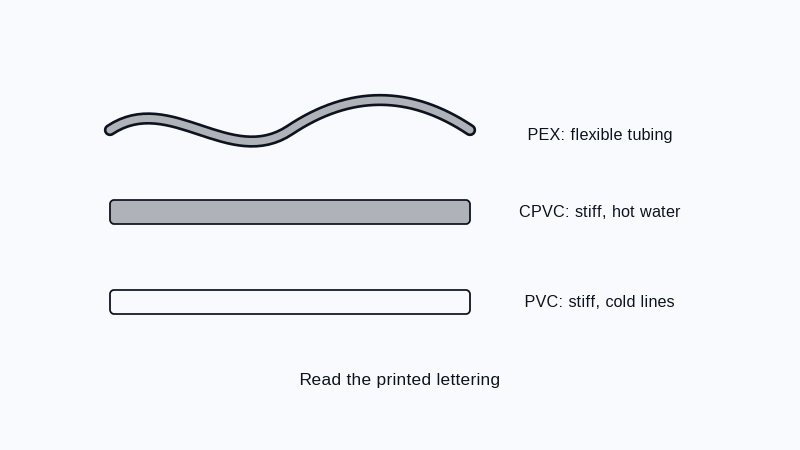
PEX connects with crimp rings, clamps or push-fit couplings, and the push-fit kind also bridges PEX to copper without tools. CPVC needs its own solvent cement rated for CPVC, not the cement sold for PVC. CPVC also tolerates hotter water than PVC does, so check the pipe's printed rating.
Many Bell bungalows and small tract houses, built in the 1920s through the 1950s, have been patched over the decades, so one wall might hold new plastic spliced into old steel. The splice itself is the usual leak point. Gray polybutylene is a separate problem. Several million North American homes received it between roughly 1978 and 1997, chlorine in the water attacks it from the inside, and replacement is the main answer; read polybutylene pipe replacement.
Common questions
What shows a plumber is overcharging?
Look for a price that rises once the plumber is inside, no written scope, a large cash deposit or a push to decide immediately. A decent plumber names the problem, shows the broken part and writes the price down. A bid with no breakdown, or one far below the rest, needs a second look before you sign.
How do you spot a dodgy plumber?
Warning signs include no contractor license number, no written estimate, a truck with no business name, and reluctance to pull a permit on a job that needs one. California requires a license at $1,000 and above and on any permit job. Look the license up on the state board's website prior to agreeing.
What marks out a good plumber?
A good one asks about the leak before arriving, then lays out options in writing, including the cheaper one. They say when a repair isn't worth doing and when a permit applies. Expect plain answers and a quote that names parts and labor rather than one number.
How do you choose a reliable plumber?
Verify the license number, gather two or more written quotes covering identical work, and find out who obtains the permit. Reliable plumbers give a start window, answer questions directly and keep deposits within the legal cap. To have us set up a visit, send your request.