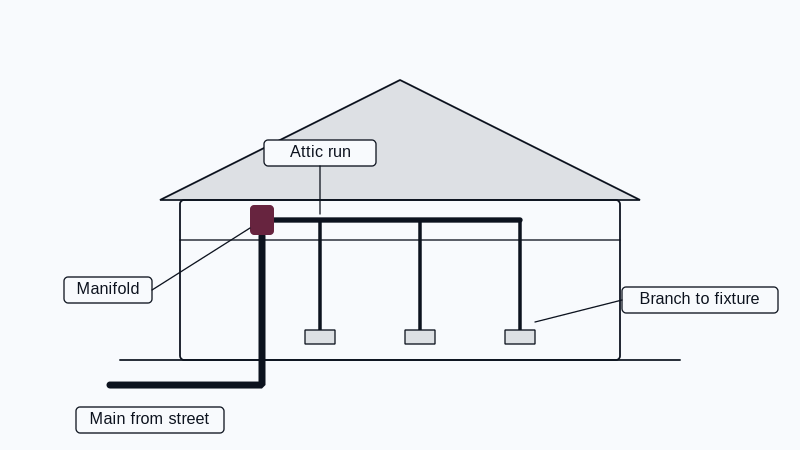
Repiping an entire house happens in stages. The plumber maps the existing supply lines, closes the water, cuts small access holes in walls or routes pipe across the attic, fits new tubing and fittings to every fixture, pressure-tests the result, and seals up. It is no weekend project, and in California it belongs to a contractor with a state license. Repiping and pipe replacement gives the overview of where it fits.
Most of what follows applies to the smaller single-story homes and duplexes common around Bell, where the pipe run is short and the attic is the easiest route. Get the sequence right and the water is back on by evening.
How does a repipe day unfold?
First the plumber tours the house, sketches the layout and prices the job. On the day itself, the water goes off, old lines are detached, PEX or copper is pulled to every fixture, joints are made, and the system is filled and pressure-tested before any wall is closed. Drywall patching and paint follow.
A typical job runs in this order:
- Walkthrough and quote. Fixture count matters more than square footage, so expect questions about every bathroom, the kitchen, the laundry room and any hose bibs.
- Permit. The plumber applies at the city building office (see the section below).
- Shut off and drain. The main valve closes, taps are opened, and the old system drains.
- Access. Small openings are cut at fixtures and corners. In many single-story houses most of the run goes through the attic or crawlspace instead.
- New lines. Tubing goes in, usually from a central manifold or along a main trunk with short branches.
- Connect fixtures and reconnect the water heater.
- Test. The new system is pressurized and watched for leaks.
- Inspection, patch and clean-up.
Who may do the work, and is a permit required?
California generally requires a contractor license once combined labor and materials reach $1,000, and always for permitted work. A repipe is both, so pick a business with a California contractor license that also pulls the permit. Check with your city's building and safety office on what it expects before work starts.
Offices differ by city, so ask for the permit number and inspection date. In Bell, building and safety sits in Community Development at City Hall, 6330 Pine Avenue. Neighboring cities run their own offices, listed on the areas we cover page. Ready to start? The quote form is where a plumber request begins.
What time does a repipe need, and what is my part?
Small homes often need one to three working days, larger houses longer, with the water off during part of each day. Clear the way to bathrooms, sink cabinets and the attic, take fragile items off walls, and arrange somewhere to wash dishes and use a toilet. Get a written schedule from the plumber ahead of day one.
Anyone living in the house should plan for dust from the access holes, and for a restricted water supply while the lines are cut over. In a rental, the landlord or manager must agree, because repiping touches the building, so tell them early. A wall patch is normally rough drywall work only; painting is usually billed on its own line of the quote.
Which houses need a repipe, and when can repairs wait?
A repipe makes sense when pipes leak in several places, when water pressure keeps dropping, when brown water shows up, or when the house still has polybutylene. Several million North American homes got polybutylene between roughly 1978 and 1997, and its fittings can fail without warning, so full replacement is the only lasting fix. More is in polybutylene pipe replacement.
Older galvanized steel clogs inside and slowly loses flow. If a single pinhole leak is the only symptom, a spot repair can hold for a while. The case for replacing the whole system is made in why repipe a house and how often to repipe a house.
What should a PEX repipe cost?
According to national guides, the average whole-house repipe is about $7,500, typically ranging from $1,500 to $15,000. One national table lists a home of 800 square feet near $3,600 and one of 1,000 square feet near $4,500, climbing with size. PEX tubing costs roughly $0.40 to $2 per linear foot, copper more, with labor a large share. These are guides, not quotes from us.
Price depends on fixture count, access, pipe material, permit fees, and wall repair afterward. Bob Vila lists permits at $50 to $500 and drywall repair at $50 to $75 a square foot, both national figures. A complete breakdown sits under repipe house cost.
Is a repipe possible on a concrete slab foundation?
Yes. With pipes cast into or under the slab, a plumber typically caps and abandons them, then routes the new lines above through the attic and down inside the walls instead of breaking the floor. That keeps the flooring intact, though more drywall openings are needed and the work is more involved.
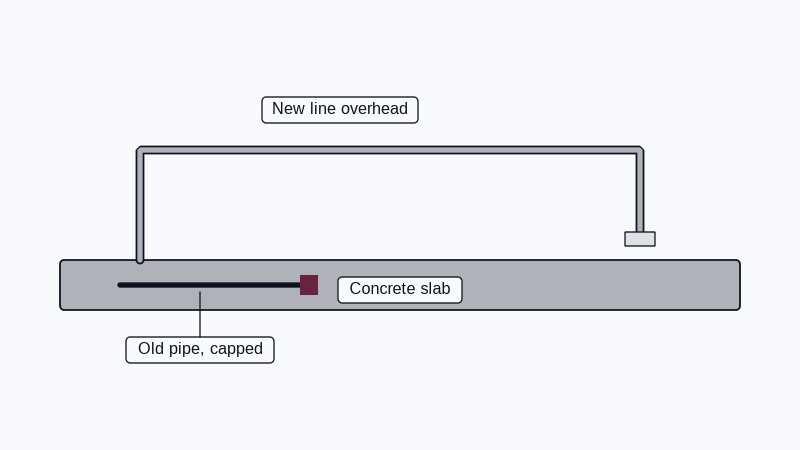
Ask the plumber how the old slab pipes will be sealed. If a leak is the only problem, a targeted repair beneath the slab may cost less than a full repipe; the tradeoff is weighed in slab leak repair or repipe.
Only an inspection tells you what runs under your own floor, so do not assume.
What does repiping with PEX involve?
PEX is a flexible plastic tubing that bends around corners, so it needs far fewer elbows and joints than rigid pipe. The plumber threads long lengths through walls and attics, connects them with crimp, clamp or push fittings, and often groups the runs at a manifold. It does not need soldering, which is why the job tends to move faster.
A few things to know about PEX, from its published properties. It is flexible, does not corrode, and is generally more resistant to bursting from freezing than copper or PVC. Sunlight breaks it down, so it must be kept out of daylight during storage and install. Yellow brass fittings have failed in some hard-water installs, so ask which fittings are used. The comparison with copper is covered in PEX vs copper.
Common questions
Is it possible to live at home while the pipes are replaced?
Usually. Water is off for part of the working day, and you will put up with dust and open walls, but the house can stay occupied. Most people plan a few days of limited water, and some arrange showers elsewhere. Ask the plumber what time the main valve goes back on each evening.
Can PEX carry drinking water safely?
PEX is approved for drinking-water plumbing, and California resolved its earlier chemical-leaching concerns and approved it for all occupancies, according to its published history. Choose pipe and fittings rated for potable water, and ask the plumber for the product names on your quote.
Do you have to open every wall?
No. Flexible tubing can be fed along existing paths, and small holes at fixtures and corners are typical. The number of open walls depends on the layout, any attic or crawlspace, and whether a slab lies under the house. Expect some patching, but not demolition.
Which questions come first when hiring for a repipe?
Request the pipe material and fitting type, the permit plan, whether wall patching and paint are covered, the start and end dates, the fate of the old pipe, and the contractor license shown on the written quote. Compare totals line by line instead of picking the lowest figure.
For the wider picture, start with Slauson Plumbing plumber.