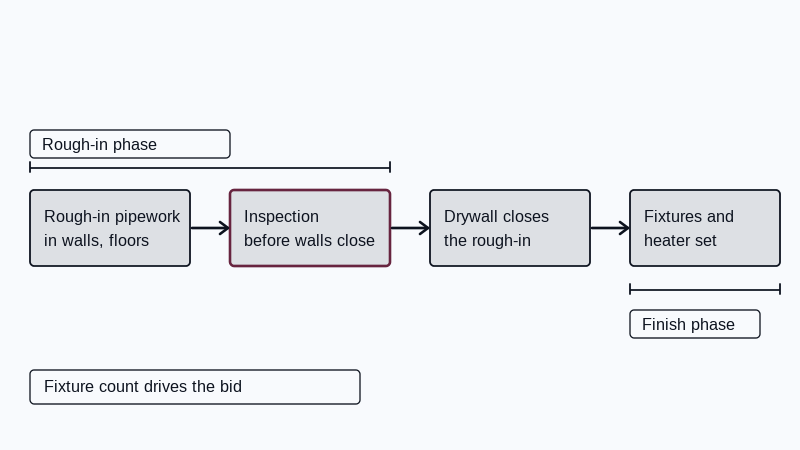
Two published guides give the same rough answer for a new house: around $4.50 per square foot for the rough-in pipework, and $10,000 to $12,000 all-in at the 2,000 sq ft mark once the fixtures are hooked up. Treat those as national benchmarks, not our quote. Building or adding a unit in Bell, Maywood or Huntington Park? How a request travels is on the Slauson Plumbing home page; opening one takes the quote form.
How much should piping a newly built house run?
This Old House says rough-in plumbing typically costs a little over four dollars a foot ($4.50) of interior space, which means roughly $9,000 at 2,000 sq ft, and that fixture connections push the total up to $10,000 to $12,000. Fixr takes another approach and quotes $2 to $6 for each square foot. Both sources are national, so Los Angeles County prices can differ.
Side by side, the two sources look like this:
| Measure | Figure | Source |
|---|---|---|
| Rough-in, per square foot | about $4.50 | This Old House |
| Rough-in, house of 2,000 sq ft | about $9,000 | This Old House |
| With fixtures connected, 2,000 sq ft | $10,000 to $12,000 | This Old House |
| Whole house, each square foot | $2 to $6 | Fixr |
| 800 sq ft home | $1,600 to $4,800 | Fixr |
| 3,000 sq ft home | $6,000 to $18,000 | Fixr |
| Rough-in, per fixture | $450 to $650 | Fixr |
The gap between sources is a warning. A square-foot figure hides the things that really set the price: how many bathrooms, how far apart the fixtures sit and what pipe you choose. Count fixtures instead and the picture sharpens.
What should a new-construction bid spell out?
A good bid separates rough-in from finish, names the pipe material, lists how many fixtures it assumes, and states what is excluded. Be careful with a single lump sum and no fixture count, since extra points are then argued over later. Compare bids on the same drawings.
Have ready before you ask anyone for a price:
- the plans, or at least a sketch showing every plumbing fixture
- the lot and foundation type
- where the meter and sewer connection sit
- the fuel for the water heater and cooktop
- your target schedule
The plumber cost page covers general pricing, and the plumber hourly guide shows how hourly work is billed if the job is small. Doing a bathroom upgrade instead of a ground-up build? A bathroom upgrade is a different animal, covered under plumbing for a bathroom remodel.
State contractor rules cover this work, and permit jobs always need a license, so check the license number first.
Where does rough-in stop and finish work begin?
Rough-in is the pipework buried in walls, floors and under the slab before drywall goes up: supply lines, drains, vents and stub-outs. Finish work follows, once the fixtures, faucets and heater are set. Many contractors price the two phases apart, with a city inspection falling in the gap.
That sequence matters for money. Rough-in is inspected before anything is covered, and a failed inspection means reopening work. For a lot inside Bell, the permit counter in Bell's building department takes care of it; neighbouring cities each run their own, so the office depends on the lot's location. Ask whether permit and inspection fees are in the bid or added afterward.
Fixr gives a timeline of roughly three to five days for plumbing a new house if nothing goes wrong. Real schedules stretch around the framers, the electrician and the Heating Air Conditioning trade, who often need the same wall cavities and ceiling space.
Which choices move the price of plumbing a new house?
Layout, materials and site conditions do most of the pushing. Spread-out fixtures, second stories, copper rather than PEX and trenching for long sewer or water runs raise the total. Stacking bathrooms back to back and keeping the water heater central bring it down. Slab foundations add cost if lines must be set before the pour.
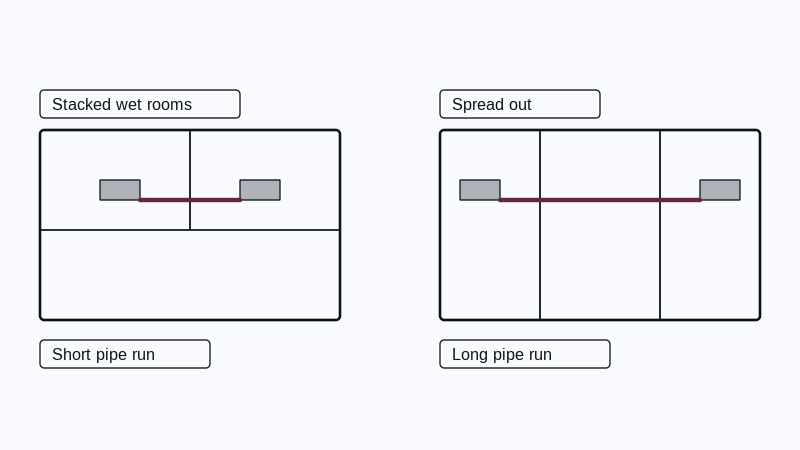
Look at the choices in your own hands:
- Stack the wet rooms. A kitchen and bathroom sharing a wall use fewer feet of pipe than ones at opposite ends.
- Pick the pipe early. PEX generally costs less to install than copper, and our PEX versus copper page compares the two materials.
- Choose the heater type. A conventional tank is the lighter spend at installation; tankless wants a heavier gas line and its own vent run.
- Freeze the fixture list. Shifting a toilet once concrete is poured means breaking it up.
- Budget for the meter and sewer connections. These are often the surprise line.
A backyard unit or garage conversion often costs more per fixture than a full house, since supply and drain lines have to travel from the main house and the sewer may need its own tie-in.
Why do fixtures matter more than floor area?
Each sink, toilet, tub, shower, washer hookup and hose bib needs its own supply run, drain and vent, which is why a tight two-story with three bathrooms costs more to pipe than a long single-story with one. Fixr prices rough-in at $450 to $650 for each fixture or faucet point in a kitchen, bathroom or laundry.
A quick way to sanity-check a bid: list every point where water comes in or goes out, multiply by a figure inside that band, and see whether the total lands near the quote. Picture two bathrooms with a toilet, sink and shower apiece, plus a kitchen sink, dishwasher, laundry box and an outside spigot. That makes thirteen points. At $450 to $650 each, the rough-in alone sits between $5,850 and $8,450, before the water heater, meter connection or finishing.
Things that are easy to leave off a bid until the end:
- the water heater, and whatever feeds it
- the line between the water meter and the building, which a bid sometimes treats as someone else's job
- gas runs for the stove, the dryer and any furnace
- backflow device for an irrigation system, where one is needed
- hose bibs, ice maker boxes and washer valves
Common questions
What is the per-square-foot rate for plumbing a build from scratch?
Published guides disagree because the method differs. This Old House puts rough-in near $4.50 per square foot, and Fixr gives a $2 to $6 range for the whole house. At that size the spread works out to about $4,000 to $12,000, so ask every bidder for the fixture count behind the figure.
How long is a plumber on site for a new build?
Fixr says roughly three to five days of plumbing work for a new house if nothing delays it. Calendar time runs longer, because the work splits into a first stage before drywall and a second after, with inspections in between. A real window needs the plans in front of the plumber.
Is plumbing cheaper in a new house than a remodel?
Per fixture, new construction tends to win on price, since walls and floors stand open and nothing needs patching. A remodel adds demolition and repair, though a new house has many more points to pipe. Compare cost per fixture, not the grand total.
Does the water heater come with the rough-in price?
Often not. Rough-in covers pipework in the structure, and many contractors treat the heater plus its gas or power hookup as finish work. Request a separate line on the bid for the heater itself, naming the brand and size you expect, so nothing is assumed.