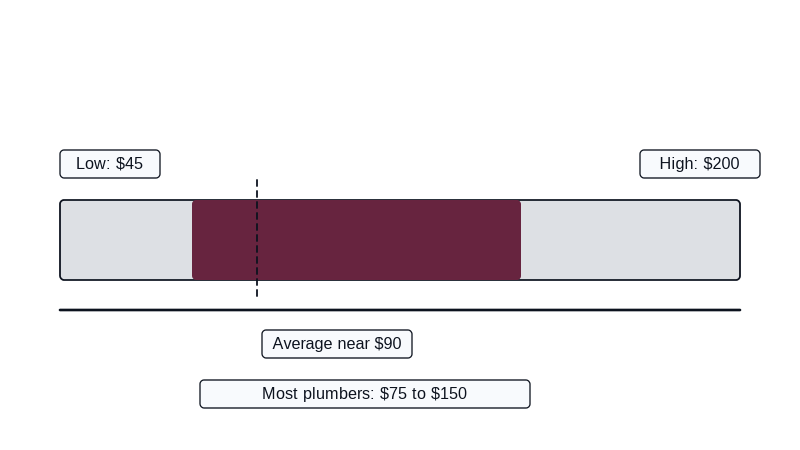
A quote reads better once you know the hourly rate behind it. One national guide lists $45 to $200 an hour, averaging $90, and says most plumbers bill $75 to $150. These are national figures rather than a Bell price list, and the number on your written quote is what counts. For how a plumber reaches you, see the Slauson Plumbing home page, or use the quote form once you have a job in mind.
What do plumbers bill hourly?
Across the country, plumbers bill $45 to $200 per hour, averaging $90, with most between $75 and $150. A master plumber costs more than a journeyman. Rates climb for emergency work, in large cities and for specialist jobs. Many plumbers quote one fixed price for a defined repair rather than an hourly rate, which makes comparison easier.
An hourly figure alone says little. Ask if the clock starts when the plumber leaves the shop or reaches your door, if a minimum applies, and if parts carry a markup. Two plumbers at the same rate can produce very different bills.
How do typical job prices compare with hourly time?
A few national figures: an outdoor spigot or hose bib replacement runs $50 to $100; a leaky shower faucet fix $75 to $200; a leaking pipe repair $150 to $350; a valve replacement $150 to $800. Slab leaks cost $1,000 to $4,000, averaging $2,500. Repiping a 2,000 square foot house costs $4,000 to $12,000.
| Job | National range |
|---|---|
| Outdoor spigot or hose bib replacement | $50 to $100 |
| Fixing a dripping shower faucet | $75 to $200 |
| Leaking pipe repair | $150 to $350 |
| Valve replacement | $150 to $800 |
| Slab leak fix | $1,000 to $4,000 |
| Repipe of a 2,000 sq ft house | $4,000 to $12,000 |
These come from published guides, so use them for judging a quote rather than predicting one. Details are in slab leak repair costs and repiping costs.
Is there a free plumbing repair estimator?
Online estimators multiply a rate by an assumed number of hours, which is the same sum you can do yourself. For a repair, do three things: get a diagnosis, get the price in writing with parts and labor split, and compare it against the national ranges above. A quote that is far outside them should come with an explanation you understand.
Heating and air conditioning contractors sometimes also do plumbing, and their rates can differ from a plumbing-only business. Ask what trade the person works in and how they price the job. Quotes should name what is included.
What does a call-out fee cover?
A call-out or minimum service fee pays for the trip and the first assessment. A national guide lists $50 to $300, with journeyman plumbers starting around $50 to $150 and master plumbers at $150 to $300. Some waive it when you proceed with the repair. Ask beforehand, not afterward.
The fee stands apart from the repair cost. A ten-minute diagnostic and a half-day job may carry an identical call-out line, so find out whether it is credited against the work.
What is the fair way to compare two quotes?
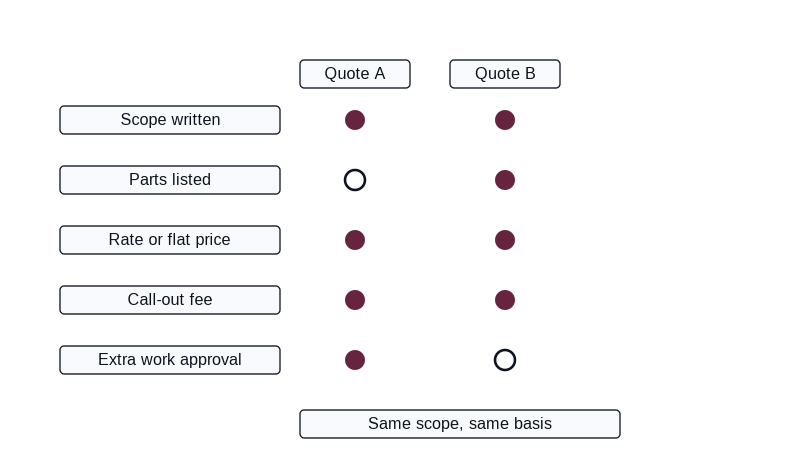
Line them up: scope, parts, hourly rate or fixed price, call-out fee, expected duration, and what happens if the job overruns. A lower quote that omits parts, permits or wall repair is not really lower. Have every plumber price an identical scope.
Fill in the quote form with the problem, adding photos if you have them. Staff read forms on weekdays between nine and five.
What does plumbing cost by the square foot?
For an entirely new home, the same guide gives $2 to $6 per square foot. That is a blunt whole-home rule of thumb, much too rough for an older house or a single repair. Its repipe range for a house of 2,000 square feet, $4,000 to $12,000, works out to the same $2 to $6, though real jobs shift with access and house size.
Use square-foot figures for a sanity check, not a budget. A bathroom remodel depends on how many fixtures move, and relocating drains costs far more than swapping fixtures in place. More is in plumber cost for a new house.
Which California rules apply when hiring a plumber?
The CSLB says a contractor license is required once labor and materials reach $1,000, and for every permitted job. Deposits are limited to $1,000 or 10 percent of the contract price, whichever is lower. Look up the license on the CSLB website before paying anything, and ask who obtains permits.
Gas piping and water heater replacement are examples of work with permits attached. Your city's building office, such as Bell Building and Safety, can say what applies. Never pay in full up front.
What extra do emergency and after-hours visits cost?
Emergency plumbers typically bill around $150 an hour, per the same guide, plus a $50 to $200 transportation fee and a flat call-out of $200 to $300. Overnight and holiday visits cost more still. Ask for the rate, the call-out and the travel charge before agreeing, and decide whether the problem can wait until morning.
Many problems feel like emergencies but are not. A dripping valve you can close, or a slow drain, usually can wait. A burst pipe, a gas smell or sewage backing up cannot. With a gas smell, exit the building, tell your gas company from outside, and contact 911 if you feel in danger. More is in emergency plumber costs.
Common questions
What hourly rate applies in California?
The national guide shows $45 to $200 an hour, mostly $75 to $150, and no California-specific figure turned up. Los Angeles-area rates may exceed the national average, yet any figure is only a guide, so rely on a written quote. Check whether the price is hourly or fixed for the job.
Is travel time billed?
Sometimes, via a call-out or transportation fee. One national guide cites $50 to $200 for transportation on emergency work. Others build travel into the minimum fee. Ask the plumber if time starts on arrival and if travel is itemized, with the answer on paper.
Which is cheaper, a flat rate or hourly pay?
A flat price protects you from a job that runs long, and an hourly rate protects you from paying for work that was quick. For a defined repair, many people prefer a flat price. For an uncertain diagnosis, hourly with a cap can be fairer. Whichever you choose, get it written.
What does replacing an outdoor spigot cost?
One national guide lists an outdoor spigot or hose bib swap at $50 to $100. Frost-free types and awkward access push it higher, and a call-out charge may apply. For leaks at the spigot itself, a repair can be cheaper than a replacement. See fixing a leaky exterior faucet.