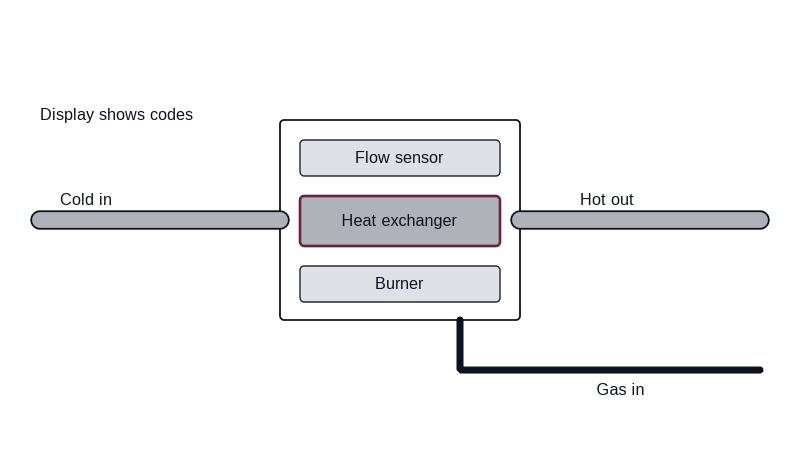
An instant, or tankless, water heater that has stopped working is rarely beyond repair. Typical culprits are limescale coating the heat exchanger, a plugged inlet screen, a gas or power interruption, a clogged vent, or a sensor that has lost its reading. Gas and venting repairs are contractor work. How visits are arranged is explained on the water heater repair page, and the quote form starts one. The home page covers everything else.
What makes an instant water heater stop heating?
Whether the unit lights and runs cool or never lights, the usual shortfall is flow, fuel or power. A minimum flow rate is needed to trigger it, so a clogged screen or a partly closed valve can leave it dead. Gas models also depend on gas supply, an open vent path and a working ignitor.
Go through this list in order before asking for help:
- Is it getting power? Gas models still run on electricity. Check the plug, the switch and the breaker.
- Is the display showing a code? Write the code down. Manufacturers publish code lists in the manual, and a plumber can read a code faster than they can guess.
- Are the service valves open? A tankless unit usually has a cold inlet, a hot outlet and, on gas models, a gas valve. A handle turned across the pipe means closed.
- Is the flow strong enough? Open a single tap fully. If flow is weak, scrub out the faucet aerator along with the unit's inlet filter.
- Did hot water start and then turn cold? That often points at a flow-sensor fault, a scaled heat exchanger or two fixtures drawing more than the unit can supply.
If a code appears again after you reset the power, stop resetting it. Repeated lockouts on a gas heater signal a problem with ignition, venting or combustion.
Why is hard water bad news for a tankless unit?
Hard water leaves calcium carbonate inside the heater, and the narrow passages in a tankless unit suffer most from that scale. The USGS says deposits form when hard water is heated, which shortens equipment life and raises heating costs. In a tankless heater you will see tepid output, more error codes and noise.

The Gateway cities draw water from several different suppliers, and hardness depends on which one serves your street. Look up the figure in your water supplier's yearly quality report; the supplier is named on your bill. Where water is hard, many makers specify a descaling flush: a small pump and two hoses push a mild acid, normally white vinegar, around the unit. Follow your own manual for the interval and the connections.
You can do a descale if you are comfortable closing valves and reconnecting hoses. Do not attempt to open the combustion chamber, adjust gas pressure or touch vent joints. A tight, correct seal matters because exhaust gas contains carbon monoxide.
If scale is the diagnosis and the unit is more than ten or fifteen years old, have the plumber quote a repair and a replacement together. The pages on what a tankless replacement costs and installation cost explain what drives each number. A softener upstream may be worth discussing too, as covered in water softener installation service.
Which problems can I check myself, and which need a contractor?
Anything on the water side that you can see and isolate is fair game for a careful owner: aerators, inlet screens, a descaling flush, resetting power. Gas piping, burner and ignition parts, vent repairs, and any change to the gas or water connections are contractor work, and replacing the unit generally involves a permit through your city.
Rough dividing line:
- Yours to try: cleaning screens and aerators, checking valves and breakers, a vinegar flush, reading codes.
- A plumber's job: a part that needs a gas shutoff, exchanger replacement, venting, a leak at a gas fitting, repeated lockouts.
- Stop and leave: an odor like rotten eggs, a hiss near the unit, soot marks, or a carbon monoxide alarm sounding.
Gas smell means exit the building. SoCalGas advises evacuating, staying clear of flames and switches, and, from a safe place, calling your gas utility, or 911 if there is danger or you cannot get through. Never attempt to fix the pipe or meter.
Water heater permits come from each Gateway city's building office, and for Bell the City of Bell Building and Safety page is the place to begin. In California, a contractor license is needed for anything totaling $1,000 or more, and for every permitted job, so look up the number with the state licensing board before you accept a replacement quote.
What do the different brands of tankless heater have in common?
Almost every brand follows the same pattern: a flow sensor, a heat exchanger, a gas valve or heating elements, a control board, and a display that reports codes. Brand matters mostly for the code list and parts. Separate pages cover Navien, Rinnai, Rheem and Noritz models.
Ahead of a visit, collect the serial and model numbers printed on the label at the side or front, the unit's age if known, and any code displayed. Photograph the display. Armed with that, the plumber can arrive with suitable parts the first time, which commonly avoids a return trip.
Plan for access, too. If the heater hangs on a garage or exterior wall, clear a path to it. A crowded garage slows the work.
One more note on timing: when hot water is completely gone and washing is impossible, state that on the form. How urgent requests are treated is on the urgent water heater repair page. Forms are read Monday to Friday, 9am to 5pm.
Common questions
How many hours does a tankless heater repair take?
Easy jobs like clearing a filter or flushing scale may need an hour or two. Replacing a sensor, ignitor or control board can fit one visit when the plumber carries the part. Heat exchanger replacement or vent repair may take longer, and parts that must be ordered mean another trip. The plumber will advise after the diagnosis.
Which questions suit a tankless repair visit?
Ask for the diagnosis, whether the part is original or aftermarket, whether fixing it beats replacing it at this age, and what the visit fee includes. Have the price written down before work begins. Find out too whether a permit applies, who pulls it, and what happens when the first fix does not hold.
Must someone be home during the repair?
Normally an adult lets the plumber in and approves the price, and the plumber will check hot water at a tap at the end. If you are a tenant, the landlord or manager may need to authorize the visit. If someone else will be there for you, tell the plumber who, and what they can approve.
Is it possible for a tankless heater to run dry of hot water?
It cannot run out the way a tank can, but it can fall short. Each unit has a maximum flow it can heat by a certain number of degrees. Two showers and a dishwasher together may ask for more than it can supply, and the water will turn lukewarm. Scale, a weak gas supply or an undersized unit makes that limit show up sooner.