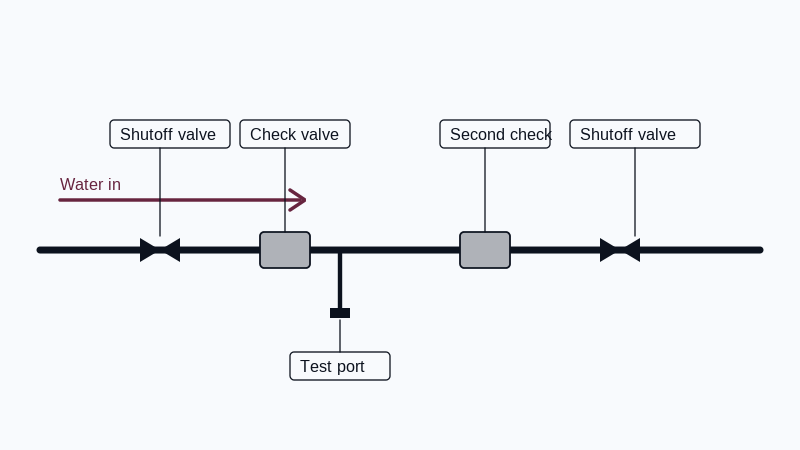
You can't run an official backflow test yourself. The test needs a gauge kit and a tester the state recognizes, and the result has to reach your water provider on time. Your jobs are to learn whether the property needs a device at all, book the tester, and file the paperwork. Plumbing permits in Bell are covered too. The Slauson Plumbing home page gives the bigger picture.
Why must a backflow device be tested?
Backflow means water moving the wrong way through a pipe. It can pull used or contaminated water back into the drinking supply, which is why codes require a prevention device on risky connections. Springs, seals and check valves inside a device wear, so a yearly test proves it still shuts.
Two things cause it. Back pressure happens when pressure inside your system rises above the supply, for example from a boiler or a pump. Back siphonage happens when supply pressure falls, such as during a main break, and water gets sucked backwards.
Common device types are check valves, double check assemblies, reduced pressure zone (RPZ) valves and air gaps. An RPZ is for higher hazards and, per the general reference on backflow, needs expert installation and an annual check. The simplest is an air gap: plain open space between a tap and the water it could touch.
How is a plumbing permit obtained in Bell?
Apply through Bell Building and Safety, located in City Hall at 6330 Pine Ave. The city's page lists plumbing permits for all plumbing work including water service, drains and water mains. Applications can be filled in, signed and emailed to [email protected], or filed through the city's OpenGov online permitting system.
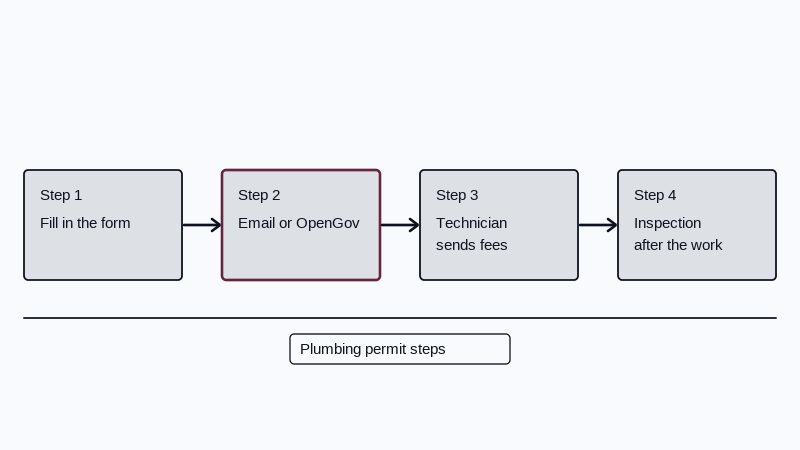
After you submit, a Building Technician contacts you with the fees and next steps. Fees depend on the kind of job, and the city says it works from Los Angeles County fees with an increase of one and a half times the adopted county fees. The page doesn't name water heaters, so ask the city whether a water heater swap needs its own permit.
Not all of this falls to you. A California contractor license is required once labor and materials together reach $1,000, and for every permitted job. A plumber doing the work normally obtains the permit; an owner should ask Building and Safety what applies before starting.
What does a backflow test involve?
Typically the tester clips a gauge to the device's test ports, works the valves in sequence and reads pressure across each internal check. Expect a brief water interruption. The result is logged as pass or fail, and a failing device is fixed or swapped and then tested once more.
A repair might mean fresh rubber parts or springs inside the body, done by the same tester or a plumber. Replacing the device normally brings a permit with it, so ask who will file.
Keep every report. Providers want one each year, and a replacement device needs a fresh test after installation.
Does my property need backflow testing?
Not every home does. LA County Public Works notes that many homes and businesses have no device, and that sites with irrigation, pools, fire sprinklers, medical care, restaurants or chemical use are the typical ones that do. A single-family house with a plain hose bib usually has nothing to test.
If you aren't sure, your water bill names your provider. In Bell that can be Golden State Water for part of the city and Cal Water's East Los Angeles district for another part, so the right office depends on your street. Ask the provider whether your service has a device on record and when it is due.
Landlords and owners of small commercial buildings are the group most often caught off guard. A duplex with a lawn sprinkler tied to the house supply, or a shop with a fire sprinkler riser, can have a device nobody has tested in years. Find the device first: it is usually a brass or bronze body with two shut-off valves, near the meter or the building entry.
When is a plumber the right choice?
Hire one for any device needing a test, any repair inside a backflow assembly, and any work on the main line. Those jobs involve permits, drinking-water safety and tools you don't own. A plumber also knows the provider's paperwork and can handle it with you.
You can handle the quiet parts yourself: finding the device, reading your provider's letter and keeping the old reports in one folder. Take a photo of the device label so the tester has the make and size ahead of the visit.
Renters should let the owner know the notice arrived, since the device belongs to the building. Your lease decides who pays. Ask for the price of the test in writing before the visit.
How do you draw plumbing plans and fill out the permit form?
For small repairs and like-for-like swaps, the form and a short job description are often enough. Larger work, such as new bathrooms, added fixtures or an ADU, comes with plans: a simple sketch showing fixture locations, pipe sizes, shut-offs and drain connections. The Building Technician tells you what the project needs.
Give the form what it asks for: owner name, address, contractor name and license, job description and value. Leave nothing blank to be filled in later. Attach photos of the existing setup if you can, since they help the reviewer.
Ask the city, not a website, for the plan standard. Each city sets its own, and Bell will tell you what a plumbing plan must show. Neighbouring cities such as Bell Gardens, Huntington Park and South Gate each have separate Building and Safety offices with their own hours, so pick the one matching your address.
Who may perform a backflow test?
Only a state-recognized backflow tester can do it. LA County Public Works says State law requires backflow prevention devices to be tested once every year by a tester the state recognizes, and that the customer arranges the test and sends the completed form back before the due date.
So the answer to how to do it is: hire the tester, and be there to give access. You don't need tools. The tester connects a differential gauge, reads pressures across each check, and fills in a report for the provider.
Rules vary by water provider, so read the notice you got. Some providers take the form by email, others through a portal. A late result can draw a notice from the provider, which is a good reason to book early.
Many plumbing businesses offer testing, and some specialist testers do nothing else. When you send a request through the quote form, mention that you need a device tested and include the provider letter if you have it. See also backflow testing services and backflow prevention testing.
Common questions
Is testing my own device allowed?
No. State law has the test done by a tester the state recognizes, and the provider only accepts the form from that person. You can inspect the device by eye for leaks or drips, and you can tell the tester what you noticed. Anything beyond that, such as opening the body, is outside what the law lets homeowners do.
How often does backflow testing happen?
Once a year, according to LA County Public Works. Your provider sends the due date, and a new or replaced device needs a test right after installation. Mark the date on a calendar, because a missed deadline can bring a violation notice from the provider.
What is the duration of a test?
One device is often finished in about an hour, though access, rust and a stuck valve can add time. Expect a short water shutoff while the tester works. A failed device needs repair and a second test, which can stretch the job over another visit.
Must I attend a permit inspection?
Someone must let the inspector reach the work. Ask Bell Building and Safety how inspections are booked and what they expect on site. If a plumber pulled the permit, they normally arrange the inspection and tell you the time window.